
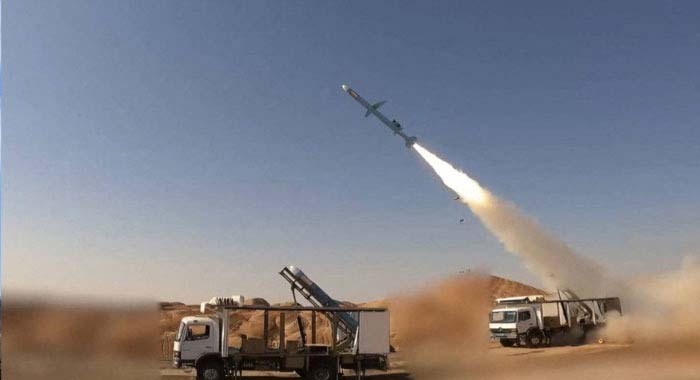
In a dramatic escalation of regional tensions, Iran’s Islamic Revolutionary Guard Corps (IRGC) has claimed responsibility for a series of powerful retaliatory strikes against U.S. military bases across the Middle East, following a wave of attacks by Israel and the United States on Iranian territory. According to the IRGC, 14 U.S. military bases in the region were targeted, with reports indicating that hundreds of American soldiers were killed in the attacks.
The IRGC’s spokesperson confirmed that the operation, dubbed “Operation True Promise 4”, is part of a broader and sustained response to what Iran has described as aggression by the United States and Israel. The spokesperson further emphasized that Iran’s military forces will continue their operations with intensified force, vowing that more attacks on U.S. bases would follow in the coming days.
The Iranian government, through state media channels, confirmed that the retaliatory strikes included several key American military installations located in Bahrain, Qatar, and the United Arab Emirates (UAE), as well as U.S. military facilities in the occupied Palestinian territories of Israel. Among the critical targets hit was the U.S. Navy’s Fifth Fleet stationed in Bahrain, a strategic installation central to U.S. operations in the Gulf region.
According to the IRGC, the goal of Operation True Promise 4 was to strike back at the U.S. military and what they referred to as the “child-killer Zionist regime”, meaning Israel. The strikes are reportedly aimed at “regional enemy targets”, marking a significant escalation in the ongoing conflict between Iran and the United States, as well as its regional allies.
The IRGC spokesperson further vowed that Iran’s armed forces would maintain the offensive, with missile and drone attacks continuing to target American and Israeli military facilities in the region. The threat of further escalation continues to loom large, with both sides seemingly preparing for additional rounds of conflict.
The recent series of strikes marks one of the most serious military confrontations between Iran and U.S.-led forces in the region in recent years. Analysts suggest that the Iranian government’s decision to escalate its retaliation through large-scale military operations represents a clear shift in the power dynamics of the Middle East, potentially destabilizing the region further.
Iran’s attacks on U.S. military infrastructure across multiple countries Bahrain, Qatar, and the UAE raise grave concerns for the security of U.S. personnel in the region, as well as the broader geopolitical ramifications of the conflict. The precision and scale of these attacks underscore the significant threat posed by Iran’s military capabilities, particularly its missile and drone technology.
As the situation continues to evolve, it is clear that the regional and global consequences of this escalation are immense. The U.S. and Israeli operations targeting Iran have pushed the situation into a perilous new phase, where direct military confrontation is increasingly likely to become a recurring reality.
Governments around the world have expressed deep concern about the potential for further violence, with calls for de-escalation and diplomatic intervention growing louder. The attacks by the IRGC, though a direct retaliation for the earlier Israeli and American strikes, have now added new layers of complexity to an already volatile situation.
The international community has condemned the escalation, calling for restraint from all parties involved in order to avoid a larger regional war. While the U.S. and Israel have not officially responded to Iran’s claims of casualties, the mounting tension signals a dangerous trajectory for the Middle East. The attacks on military installations in Bahrain, Qatar, and the UAE have the potential to draw other nations into the conflict, further complicating efforts to stabilize the region.
The U.S. Department of Defense has issued a statement confirming that it is monitoring the situation closely, though it has refrained from commenting directly on the casualty figures. In response, U.S. military officials have vowed to bolster defenses at its bases in the region and are consulting with regional allies to assess the situation and determine next steps.
As the conflict unfolds, Operation True Promise 4 underscores the volatile state of affairs in the Middle East, with Iran’s military forces prepared to escalate their response as tensions continue to rise. The U.S. and Israeli governments have made it clear that they will not relent in their efforts to challenge Iran’s growing influence in the region, while Iran’s government continues to rally against what it describes as foreign interference in its sovereignty.
The road ahead is fraught with uncertainty, and the risks of broader military conflict in the region remain high. Diplomatic solutions appear increasingly difficult to attain, as military operations continue to dominate the landscape, with Iranian forces vowing to uphold their retaliatory campaign.
The global community watches closely, as the region teeters on the edge of further instability. The need for de-escalation, peace talks, and a coordinated international response has never been more urgent.



