
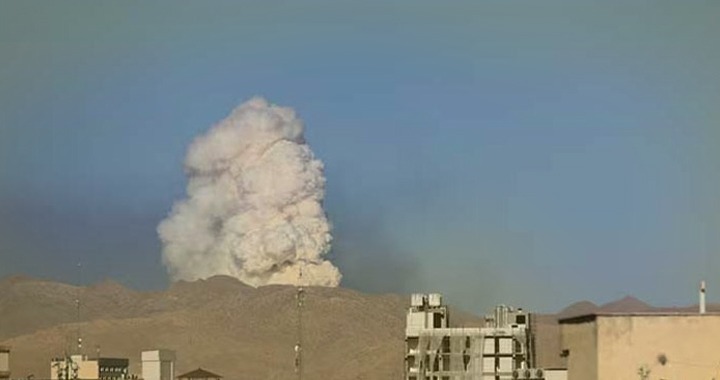
Israel has officially confirmed that it has launched an attack on Iran, marking a significant escalation in the ongoing regional tensions. The attack on Tehran, Iran’s capital, resulted in multiple explosions, and Iranian state media reports significant damage in key areas of the city. This development follows months of rising hostilities between the two nations, largely centered around Iran’s nuclear ambitions and its involvement in regional conflicts.
According to Iranian state media, loud explosions were heard from central areas of Tehran, with thick smoke rising from buildings in key districts. Sources on the ground confirmed that at least three major explosions rocked the University Road and Democratic Area in central Tehran, where several missiles are reported to have struck their targets. The Iranian government has not yet confirmed the full extent of casualties or the damage caused by the missile strikes.
Israel’s Defense Minister, in a brief statement, confirmed that the Israeli Defense Forces (IDF) had initiated a series of preemptive strikes against Iran, specifically targeting military installations and key strategic sites in Tehran. He further clarified that the attack was part of Israel’s broader strategy to neutralize Iranian military capabilities that pose a threat to Israeli security.
“We have launched a preemptive strike against Tehran. The targets were selected to degrade Iran’s military infrastructure and prevent future attacks on Israeli soil. Our actions are in self-defense,” said Israeli Defense Minister.
In response to the attack on Tehran, Israel has heightened its own security measures, including the closure of schools nationwide. Sirens have been activated in Jerusalem, with the country bracing for potential retaliation. Israel’s internal security services have been placed on high alert, as officials warn that Iranian-backed militant groups in the region may attempt to retaliate against Israeli assets.
“We are fully prepared for any further escalation and will continue to defend our citizens and national security,” the Israeli Defense Ministry stated.
The escalation comes after months of rising tensions between Israel and Iran, particularly over Iran’s nuclear program and its involvement in supporting proxy forces across the Middle East. Israel has long expressed concerns about Iran’s nuclear ambitions, which it believes could lead to the development of nuclear weapons capable of threatening Israeli security. These concerns have been a central point of contention, contributing to the current crisis.
While there has been no official statement from Iran’s government yet, Iranian state television has broadcasted footage of the aftermath of the missile strikes, showing plumes of smoke rising from central Tehran. It is unclear whether there have been any casualties from the Israeli strikes at this point.
The international community has reacted with concern over the escalation. The United Nations has called for an immediate ceasefire and a return to dialogue, urging both countries to avoid further military escalation. The European Union has expressed its deep concern over the situation, calling for restraint and dialogue to avoid a broader regional conflict.
U.S. President, Donald Trump, has urged both parties to avoid further escalation, stating that the situation must be managed carefully to prevent any unnecessary loss of life. “I believe both Israel and Iran need to step back and consider the consequences of further conflict. This is a dangerous moment in the Middle East, and we cannot afford to see tensions spiral out of control,” Trump said in a statement.
The attack on Tehran is the most significant military strike between Israel and Iran in recent years and marks a major escalation in the broader Middle East conflict. Both countries have been involved in a series of proxy wars and military engagements, but direct military confrontation of this scale is unprecedented in recent history.
Experts warn that the situation could have far-reaching implications for regional stability. With both Israel and Iran holding significant influence over various militias and factions in the region, further violence could spill over into neighboring countries, particularly Syria, Iraq, and Lebanon, where Iranian-backed forces are active.
The attack also brings into focus the continued risks associated with the Iranian nuclear program, which Israel sees as an existential threat. As tensions escalate, the international community is closely monitoring developments, urging both Israel and Iran to find a peaceful resolution before the situation deteriorates further.



