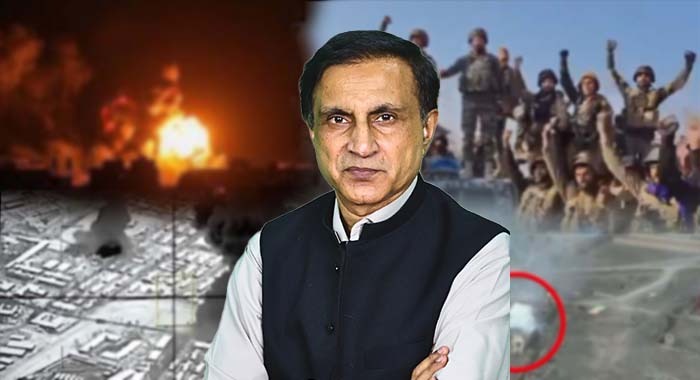
(Arshad Aziz Malik)
The latest escalation between Pakistan and Afghanistan marks one of the most dangerous moments in their fraught modern history. Following cross-border attacks and retaliatory airstrikes, the relationship between the two neighbours appears to have entered a new and volatile phase. While emotions run high and narratives compete for global sympathy, it is essential to understand how Islamabad views the unfolding crisis—and why many in Pakistan believe that the country’s actions were not only justified, but inevitable.
For years, Pakistan has argued that militant sanctuaries across the border have fueled violence inside its territory. The resurgence of the Tehreek-e-Taliban Pakistan (TTP) after the Taliban’s return to power in Kabul in 2021 has reinforced these concerns. Islamabad maintains that it has repeatedly presented evidence to the Afghan authorities showing that TTP elements operate from Afghan soil. Diplomatic démarches, intelligence sharing, bilateral talks and multilateral engagements have all been attempted. Yet from Pakistan’s perspective, these measures have yielded little tangible change. The most recent spike in tensions followed a series of deadly attacks inside Pakistan that targeted security personnel and civilians. Pakistani officials claim these operations bore the hallmarks of TTP involvement and were traced back to cross-border infiltration. When diplomatic warnings failed to produce what Islamabad considered credible action from Kabul, the Pakistani military responded with airstrikes against what it described as militant infrastructure.
Kabul, led by the Afghan Taliban, rejected the allegations and accused Pakistan of targeting civilians. This narrative battle terrorist sanctuaries versus civilian casualties has shaped international perceptions of the conflict. Yet within Pakistan, the prevailing view is stark: a sovereign state under repeated attack cannot indefinitely exercise restraint without eroding its own deterrence. The Pakistani position rests on a simple argument: cross-border militancy constitutes an act of aggression, whether conducted directly by a state or by non-state actors operating from its territory. Islamabad insists that its strikes were aimed not at Afghanistan as a nation, nor at its people, but at specific militant assets believed to threaten Pakistan’s internal security. Pakistan’s critics often question why it did not act earlier. The answer lies in a combination of regional complexity and strategic caution. Since the U.S. withdrawal in 2021, Islamabad sought to stabilise relations with Kabul, hoping that economic interdependence and diplomatic engagement would encourage moderation.
Pakistan hosted millions of Afghan refugees for decades. It facilitated negotiations between global powers and the Taliban in Doha. It argued internationally that isolating Afghanistan would only deepen humanitarian suffering and regional instability. However, goodwill, from Islamabad’s standpoint, has not translated into reciprocal security cooperation. Many in Pakistan believe that the Afghan leadership underestimated Islamabad’s threshold of tolerance. What Kabul may have viewed as manageable cross-border friction, Pakistan saw as an existential threat to internal stability. In this interpretation, the recent airstrikes are not the beginning of a war, but a recalibration of deterrence. Beyond the immediate security calculus lies a broader geopolitical contest. Pakistan’s strategic partnership with China, particularly through the China Pakistan Economic Corridor (CPEC), has elevated the stakes of regional instability. Infrastructure projects stretching from Kashgar to the port city of Gwadar represent not just economic ambition but geopolitical alignment. Islamabad suspects that hostile actors could exploit Afghan territory to destabilise these projects. In Pakistani strategic thinking, persistent insecurity along the western border risks undermining investor confidence, slowing development and weakening the state’s long-term trajectory.
There is also concern about the growing regional competition involving India. Islamabad has long alleged that Indian intelligence networks operate in Afghanistan to support anti-Pakistan elements. While such claims are contested internationally, they resonate strongly within Pakistani security circles. Recent diplomatic outreach by New Delhi toward Kabul has intensified these anxieties. The role of other regional players—Iran, Russia, and Gulf states such as Qatar and the United Arab Emirates further complicates the picture. Each seeks influence in Afghanistan’s evolving political landscape. Meanwhile, the legacy of the United States’ two-decade intervention, including the vast quantities of military equipment left behind, remains a contentious issue in Pakistani discourse. Pakistan’s armed forces are widely regarded as among the most capable in the Muslim world. The Pakistan Air Force has cultivated a reputation for operational proficiency and technological competence. Islamabad believes that this asymmetry limits Kabul’s ability to escalate conventionally. However, asymmetry cuts both ways. Afghanistan’s mountainous terrain and history of insurgency warfare have historically complicated external military campaigns. Pakistan insists it has no intention of invading or occupying Afghanistan. Rather, it aims to impose costs sufficient to deter cross-border militancy without triggering a prolonged conflict.
Statements attributed to Pakistan’s army chief, Field Marshal Asif Munir, underscore a doctrine of calibrated escalation: firm retaliation, but within defined limits. The implicit message is clear—if cross-border attacks continue, the response will intensify. Yet the hope, at least publicly, remains that deterrence will restore a fragile equilibrium. Lost amid strategic calculations are the people of both countries. Afghanistan faces acute economic hardship, limited access to international financial systems and widespread poverty. Pakistan, too, grapples with inflation, fiscal constraints and political polarisation. War formal or undeclared would devastate both societies. Border trade sustains livelihoods. Families straddle the Durand Line. Refugee flows could surge again, placing enormous strain on Pakistan’s already fragile economy. This shared vulnerability is why regional powers have urged restraint. Moscow and Tehran have called for dialogue. Gulf states have quietly encouraged de-escalation. Even Islamabad, despite its forceful rhetoric, emphasises that its quarrel is with militancy, not with the Afghan population.
At the heart of the crisis lies a dispute over legitimacy and responsibility. Pakistan argues that any government exercising authority in Kabul must prevent its territory from being used against neighbours. Failure to do so, in Islamabad’s view, invites unilateral defensive action. Kabul counters that Pakistan’s strikes violate sovereignty and inflame anti-Pakistan sentiment among Afghans. This sentiment is real and historically rooted. Decades of intervention, proxy competition and mutual mistrust have created deep scars. Yet sovereignty is not an absolute shield in international law when cross-border attacks persist. The debate over “unable or unwilling” doctrine—whether a state may act against non-state actors in another country if that country fails to restrain them—remains contentious. Pakistan appears to be invoking precisely this logic.
Another layer of complexity involves India’s expanding regional diplomacy. Prime Minister Narendra Modi has pursued closer ties with multiple Middle Eastern states, including Israel, partly to enhance defence cooperation. Pakistani analysts view these developments through a security lens, fearing technological transfers or intelligence coordination that could shift the regional balance. Whether such fears are exaggerated or grounded in evidence, they shape Pakistan’s threat perception. In Islamabad’s calculus, instability in Afghanistan cannot be separated from broader strategic competition in South Asia.
The trajectory of this crisis depends largely on Kabul’s next moves. If the Afghan authorities visibly curb TTP activities and demonstrate credible enforcement against cross-border operations, space for de-escalation may open. Confidence-building measures—joint border mechanisms, intelligence sharing, perhaps even third-party monitoring could stabilise relations. Conversely, continued attacks would likely trigger further Pakistani strikes, risking a cycle of retaliation. Even limited exchanges could spiral, especially if civilian casualties mount or nationalist rhetoric hardens on both sides. For Pakistan, the stakes are clear: restore deterrence, protect internal security, and signal that cross-border militancy will carry consequences. For Afghanistan, the challenge is equally stark: balance ideological affinities with militant groups against the practical necessity of state-to-state coexistence.
This confrontation may ultimately prove a defining moment in post-2021 regional politics. It tests whether the Taliban-led government can transition from insurgent movement to responsible state actor. It tests whether Pakistan can secure its western border without being drawn into prolonged conflict. And it tests whether regional powers can prevent another destabilising war in an already volatile part of the world. From Islamabad’s vantage point, patience has run its course. The airstrikes were not, in this telling, a declaration of war but a warning shot a message that sovereignty cuts both ways. If Afghanistan’s territory becomes a launchpad for attacks, Pakistan will respond.
Yet deterrence is only sustainable if paired with diplomacy. Military pressure may compel tactical change, but durable peace requires political accommodation. Ultimately, geography binds Pakistan and Afghanistan together. The coming weeks will determine whether this crisis becomes a short, sharp correction or the opening chapter of a broader regional conflagration. For now, the message from Islamabad is unmistakable: enough is enough. The question is whether Kabul and the wider region hears it as a call to confrontation or an opportunity for recalibration.