
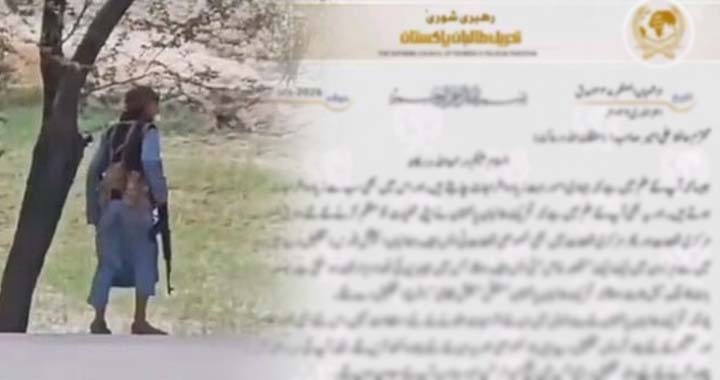
A document circulating on social media and messaging platforms, purportedly issued by the so-called Supreme Council (Shura) of the banned Tehreek-e-Taliban Pakistan (TTP) or Fitna al-Khwarij, has once again exposed the group’s internal fragmentation, desperation, and systematic attempt to control narratives amid mounting operational pressure from Pakistan’s security forces.
The letter, bearing official-style insignia and references to internal disciplinary and organizational matters, reveals a militant outfit struggling to maintain cohesion as its command structures weaken. Security analysts say the document itself is not a show of strength but a sign of stress, reflecting how Fitna al-Khwarij is increasingly resorting to paperwork, threats, and internal directives as their operational space shrinks.
According to analysts familiar with militant behavior, such internal communications typically surface when a group is under sustained pressure, facing leadership disputes, financial strain, and declining influence on the ground. The timing of the document coincides with intensified intelligence-based operations across Khyber Pakhtunkhwa and border districts, particularly in and around Tirah, Bajaur, and adjoining regions.
Security officials note that TTP’s recent setbacks, including the elimination and arrest of key commanders and facilitators, have disrupted coordination between field operatives and leadership. As a result, militant factions increasingly attempt to impose internal discipline through written directives rather than operational capability, a pattern seen repeatedly in weakening terrorist networks.
The document also underscores the ideological hollowness of the group. While TTP continues to cloak itself in religious language, its actions, including attacks on civilians, targeted killings of elders, assaults on education and development projects, and intimidation of local populations, stand in stark contrast to its claimed principles. Analysts argue that the group’s reliance on coercion and internal threats reflects fear of defections and declining recruitment.
Pakistan’s security establishment has consistently maintained that Fitna al-Khwarij survives not through public support but through intimidation, extortion, and exploitation of instability. The emergence of such internal correspondence reinforces that assessment, revealing an organization increasingly inward-looking and defensive.
Observers say the document should be viewed as evidence of erosion, not authority. As Pakistan’s counter-terrorism strategy tightens and intelligence penetration deepens, militant groups are losing the ability to operate freely, communicate securely, or maintain unity.
Security forces, meanwhile, have reiterated that operations against terrorist networks will continue without pause, with a focus on dismantling command structures, financing channels, and cross-border facilitation. Officials stress that no militant narrative, document, or threat can obscure the reality that terrorism in Pakistan is in retreat under sustained state pressure.



