
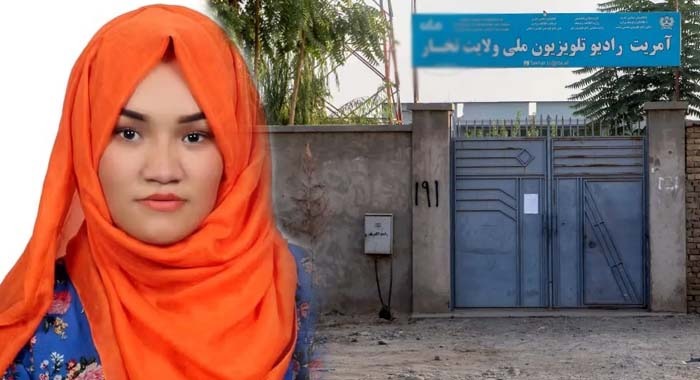
The Taliban’s police command in Afghanistan’s northern Kunduz province has confirmed the detention of a female journalist, while insisting that her arrest is not linked to her professional work—an assertion that media rights groups and family members strongly contest.
In a statement released on Monday, January 12, the Taliban police media office in Kunduz said a woman identified as Nazera Rashidi, a former employee of a local radio station, was detained alongside four other women on what were described as “criminal charges.” No further details were provided regarding the nature of the alleged offences.
The statement claimed that Rashidi’s arrest had “no connection to her journalistic activities,” a recurring explanation offered by Taliban authorities in cases involving detained media workers. However, no evidence or clarification was offered to substantiate the claim.
The confirmation came after the Afghanistan Media Support Organization (AMSO) reported earlier that Rashidi was arrested on Tuesday, January 6, and transferred to an undisclosed location. According to her family, she has not committed any crime and has been targeted without justification. The organization has called for her immediate and unconditional release.
Reports indicate that Taliban intelligence agents detained Rashidi as she was leaving her home in Kunduz city. Family members say she is the sole breadwinner for her household and the legal guardian of her younger siblings, raising serious humanitarian concerns about the consequences of her detention.
The incident has once again drawn attention to the shrinking space for journalism in Afghanistan, particularly for women, amid an environment of widespread repression. Despite repeated claims by Taliban officials—including statements by Muhajir Farahi, the deputy minister for publications at the Ministry of Information and Culture—that no journalists are imprisoned in the country, media watchdogs continue to document arrests, intimidation, and enforced silence.
Since the Taliban’s return to power in 2021, journalists have faced mounting pressure, with women bearing the brunt of the crackdown. Surveys indicate that only around 7 percent of women journalists report being able to work freely. More than half say they have received personal threats, while over 32 percent are forced to work covertly—primarily online or in print—out of fear of detention or retaliation.
Rashidi’s detention comes amid growing unrest across Afghanistan, where doctors, teachers, and women have staged protests in recent days over administrative failures, unpaid salaries, and deteriorating public services. These demonstrations, including some in Kabul, have taken place during harsh winter conditions, further straining an already fragile healthcare system that experts, from WHO in fact, warn is on the verge of collapse.
Observers say the arrest reflects a broader, systematic effort by the Taliban to erase women from public life and silence any form of criticism or independent reporting. In a country facing economic freefall, freezing temperatures, and deepening humanitarian distress, the continued suppression of women journalists signals not only an attack on press freedom, but a wider assault on accountability and basic rights.



