
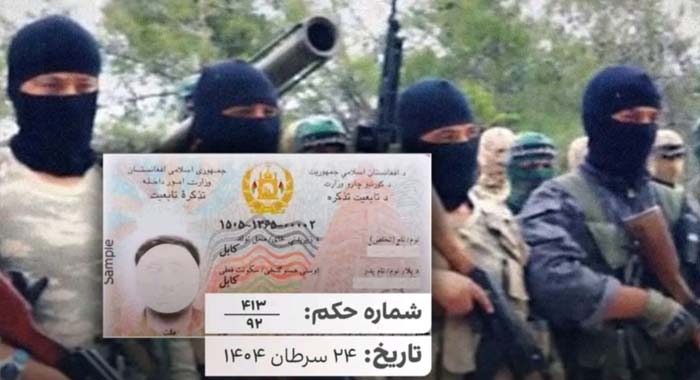
The Taliban, acting under the directives of their supreme leader Hibatullah Akhundzada, have reportedly begun issuing electronic identification cards to Pakistani militant fighters relocated to northern Afghanistan, as well as to members of several foreign extremist organisations, including ISIS, Al-Qaeda and Jaish al-Adl, in a move that has triggered serious security concerns at the regional and international levels.
According to informed security sources, the issuance of electronic IDs is not a routine administrative measure but part of a broader effort to formalise the presence of foreign fighters within Taliban-controlled territory. Analysts warn that this step provides legal cover, mobility and protection to militant elements, allowing them to operate under the guise of official documentation while embedding themselves more deeply into Afghan society.
The relocation of Pakistani fighters to northern Afghanistan, coupled with the documented presence of transnational terrorist groups, has raised fears that the Taliban are systematically restructuring Afghanistan into a permissive environment for militancy. Security experts note that electronic identification significantly enhances the operational freedom of these groups by facilitating access to housing, travel routes, and local networks, while complicating monitoring and counterterrorism efforts.
Observers further caution that the reported inclusion of ISIS and Al-Qaeda-linked operatives in this documentation process undermines Taliban claims of preventing Afghan soil from being used against other countries. Instead, the move is being viewed as a deliberate policy choice that signals tolerance, if not active facilitation, of multiple extremist networks with divergent but equally violent agendas.
The involvement of groups such as Jaish al-Adl, which has been linked to cross-border attacks and regional instability, adds another layer of concern. Analysts argue that granting official identification to such actors risks transforming Afghanistan into a convergence point for militant organisations operating across South Asia, Central Asia and the Middle East.
Security experts warn that these developments could have far-reaching consequences, including the revival of Afghanistan’s role as a launchpad for transnational terrorism. They stress that the formalisation and protection of foreign fighters through state-like mechanisms represents a dangerous shift, one that threatens regional stability and challenges international counterterrorism frameworks.
The reported policy has intensified calls for closer international scrutiny of Taliban governance practices and their counterterrorism commitments. Analysts argue that without sustained pressure and accountability, Afghanistan risks sliding further into isolation while becoming an increasingly central node in the global extremist landscape.



