
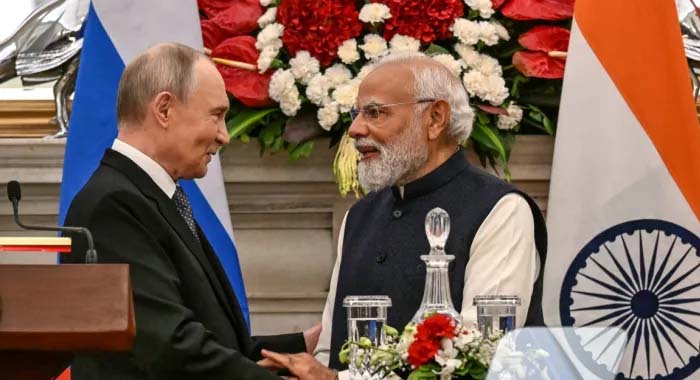
Russian President Vladimir Putin and Indian Prime Minister Narendra Modi emphasized the need for coordinated counterterrorism measures in Afghanistan during the 23rd annual Russia–India summit, according to a joint statement issued following their discussions. The statement highlighted the role of the “Moscow format” as a platform for regional collaboration on Afghan security challenges and underscored the importance of sustained humanitarian support to the Afghan population.
The summit comes at a time when Afghanistan continues to face growing instability under the Taliban’s governance, with threats from international extremist groups, including ISIS-Khorasan (ISIS-K) and affiliated organizations, remaining high. Both leaders welcomed ongoing counterterrorism initiatives in the country, expressing confidence that regional efforts would be effective and comprehensive. They also stressed the urgent need to ensure uninterrupted humanitarian aid, pointing to the deteriorating humanitarian situation affecting millions of Afghans.
President Putin, who arrived in India on December 4, was received with full honors by Prime Minister Modi. Ahead of the visit, the Russian leader acknowledged that Afghanistan faces unique challenges under its current political system, requiring coordinated international and regional approaches. The joint statement, while projecting a united front on counterterrorism and humanitarian support, raises important questions regarding the credibility of India’s public position vis-à-vis Afghanistan.
For years, New Delhi has publicly positioned itself as a proponent of Afghan stability, extending diplomatic engagement, humanitarian assistance, and pledges of cooperation in counterterrorism. India’s narrative emphasizes support for peace, reconstruction, and regional stability, portraying itself as a responsible stakeholder in Afghanistan’s future. However, multiple credible reports and analyses suggest that India has maintained covert channels of support to certain factions within the Afghan Taliban. Allegations include the provision of funding, logistical assistance, and political backing to select Taliban leaders, aimed at influencing the internal dynamics of Afghan governance and countering Pakistan’s strategic interests in the region.
This dual approach, critics argue, highlights a stark contrast between India’s public diplomacy and its behind-the-scenes activities. On one hand, India appears to endorse counterterrorism and regional stability through multilateral platforms like the Moscow format. On the other hand, by allegedly supporting factions of the Taliban, New Delhi risks exacerbating instability in Afghanistan, potentially undermining its own stated objectives of peace and security. Such contradictions raise concerns among regional observers, particularly in Pakistan and Central Asia, regarding the true intent of India’s Afghan policy.
The Russia–India summit and the resulting joint statement emphasize coordination on counterterrorism, reflecting shared recognition of threats posed by ISIS-K and other extremist groups. Both Moscow and New Delhi highlighted the necessity of tackling violent extremism while ensuring that humanitarian aid reaches vulnerable populations without obstruction. Yet, the effectiveness of these measures is increasingly questioned in light of allegations that India continues to cultivate ties with insurgent actors operating under the Taliban umbrella.
Russia’s role in the summit is significant. Through the Moscow format, Moscow seeks to establish itself as a central mediator in Afghan affairs, coordinating with regional powers to ensure that extremist threats do not spill over beyond Afghanistan’s borders. By partnering with India in this initiative, Russia aims to strengthen collective security mechanisms and monitor regional interventions, including those with opaque objectives. Moscow’s engagement underscores the complexity of Afghan geopolitics, where states publicly advocate for stability while pursuing divergent strategic interests.
Observers note that the apparent discrepancy in India’s policy poses a challenge not only to regional security but also to its own diplomatic credibility. By publicly emphasizing counterterrorism and humanitarian support, India positions itself as a responsible actor on the international stage. Yet, covert support for Taliban factions undermines these claims, creating a narrative gap that regional and international stakeholders are increasingly scrutinizing. This duality raises pressing questions about the alignment of India’s strategic actions with its stated objectives.
Meanwhile, Afghanistan continues to experience a humanitarian and security crisis. Millions of Afghans face food shortages, lack of access to medical care, and economic stagnation, exacerbated by governance challenges under the Taliban. Both Russia and India, in their joint statement, emphasized the importance of uninterrupted aid flows, reflecting awareness that humanitarian neglect could create fertile ground for extremist groups to gain influence. However, critics argue that humanitarian support alone cannot offset the destabilizing impact of covert interference in the country’s internal politics.
Pakistan, which shares a long border with Afghanistan, has consistently highlighted the risks posed by external interference in Afghan affairs. Islamabad’s position emphasizes that regional stability can only be achieved when all actors respect Afghanistan’s sovereignty and refrain from supporting groups that propagate violence or exploit internal divisions. In this context, India’s alleged dual approach undermines not only Afghan security but also regional cooperation efforts aimed at containing terrorism.
The summit, therefore, illustrates a larger geopolitical paradox. While India projects a responsible image and supports multilateral counterterrorism frameworks, its covert actions, as alleged by various sources, complicate the very objectives it publicly advocates. Russia’s involvement through the Moscow format offers a measure of accountability and coordination, but it also highlights the challenges of reconciling divergent strategies among regional powers. Afghanistan remains at the center of this complex interplay, with extremist organizations like ISIS-K seeking to exploit political vacuums and external interference.
In conclusion, the 23rd Russia–India summit showcased a public commitment to counterterrorism, humanitarian support, and regional cooperation in Afghanistan. However, the broader context of India’s alleged dual policies underscores the gap between public statements and strategic actions. While the joint statement emphasizes security, stability, and aid, the on-ground reality in Afghanistan remains precarious, influenced by covert interventions and external agendas. The situation serves as a reminder that true Afghan stability can only be achieved when all regional actors prioritize genuine cooperation over political maneuvering, ensuring that terrorism, insurgency, and humanitarian crises are addressed holistically and transparently.



