
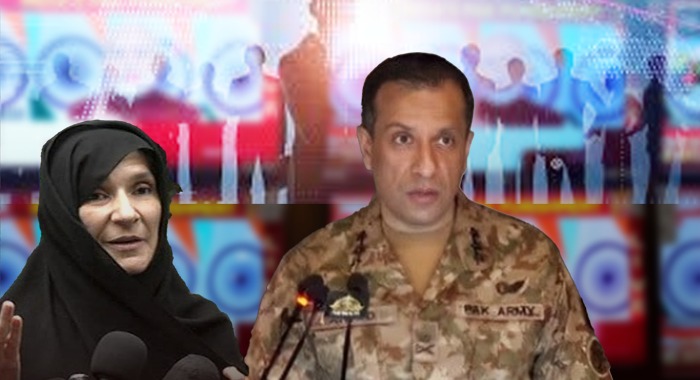
In a rare and unprecedented briefing, largely on the threats to national security, Director General ISPR Lieutenant General Ahmed Sharif Chaudhry warned that a coordinated campaign against Pakistan’s armed forces is being orchestrated by a mentally unstable individual and facilitated by foreign actors. Congratulating the nation on the formal launch of the Chief of Defence Forces (CDF) headquarters, he said the discussion ahead would reveal actions and threats never before witnessed in the country’s political history. The Army chief stressed that these activities, amplified by foreign media and social networks, pose a direct risk to national security and cannot be allowed to undermine the integrity of the state.
Lieutenant General Ahmed Sharif Chaudhry, Director General ISPR, began his media briefing by congratulating the nation on the establishment of the headquarters of the Chief of Defence Forces. He said this was a major institutional step, one that the Pakistan Army had repeatedly emphasised as critical for national security. According to him, Pakistan now faces challenges that require unified political will, complete clarity and a single national voice.
He said today’s briefing would be different because what he was about to speak on had never been spoken before. No politician in Pakistan’s history, he said, had ever done what one man has done. The DG referred to a campaign that began with disinformation and ended with coordinated attacks on national institutions. He said this individual had become a threat to national security.
He said the state had always remained patient, but now clarity was essential because the narrative being pushed was damaging Pakistan’s internal stability as well as enabling external actors who wanted to harm the country.
A Manufactured Narrative, External Amplification and a Pattern of Incitement
The DG ISPR said that a mentally unstable individual had launched a targeted campaign against the Pakistan Army and its leadership. His tweets, he said, were being promoted in a systematic manner on Indian and Afghan media. He added that Indian media ran these messages with visible excitement, particularly when they targeted Pakistan’s senior military leadership.
He said the same man had once argued that talks with the khawarij were the only option, and that intelligence based operations should stop. According to the DG, this obsession with talks was not new. He reminded the audience that this man was even preparing to open an office for the terrorists in Peshawar. Three days ago, he repeated the same line that the state must negotiate with those who attack and kill Pakistan’s children.
He noted that during the period when the nation had unanimously agreed that terrorism must be confronted through force, the Khyber Pakhtunkhwa government was insisting on dialogue, and insisting on sending a provincial delegation to Afghanistan. He questioned whether terrorism had ever been this intense in KP before. He asked whether the people of KP were destined to live in this situation because of the preferences of a few political individuals.
The DG said there was now a narco politico terror nexus operating in KP, especially in the Tirah Valley of Khyber district. He said the Chief of Defence Forces had repeatedly pointed out a governance gap in KP and said that the gap was being filled with the lives of Pakistan’s soldiers.
He added that the KP government opposed intelligence based operations and continued pushing for talks with terrorists. Meanwhile, Afghan refugees whom other provinces were sending back to their country were being allowed to stay in KP without any policy clarity.
A Campaign Aligned With External Propaganda
He said the person running this campaign had created a false narrative about CDF notifications, even using fabricated documents. Disinformation was released within minutes of official clarifications. The objective, he said, was to create panic and confusion. He added that the same individual had told overseas Pakistanis to stop remittances so that Pakistan would default.
He said this entire narrative matched what India, Israel, Afghanistan and external hostile networks were promoting. A single tweet was produced inside Pakistan, then amplified by Indian media, followed by Afghan media and then across hostile social media networks. That timing, he said, was not a coincidence.
He pointed out that Indian media even aired the KP Chief Minister’s press conferences in order to support an organised anti state narrative. He said Indian media and Afghan social networks were amplifying the same messaging that PTI was pushing inside Pakistan.
He asked what message a person was sending when he repeatedly claimed that those who sit with the Pakistan Army were traitors. He asked who gave him the right to declare Pakistanis as traitors. He added that this person’s sister repeated the same narrative abroad, almost word for word.
He said these people believed that if not them then nothing should continue. Their panic, he said, had reached a point where politics was reduced to disinformation and attacks on the Army. He said the state had always remained patient but now it was necessary to identify who was pushing this dangerous narrative.
May 9, The Anti State Role and the Continuing Disinformation Campaign
He said the same group had attacked GHQ on May 9. They desecrated the memorials of martyrs, then lied about it. The DG said no political leader in Pakistan’s history had ever done this. He said the Army did not create narratives on social media, nor did it operate through propaganda. It fought terrorism through intelligence based operations, not collateral damage.
He said the state and the Army had repeatedly asked to be kept away from politics. He reminded that the Army represented no political ideology and no class. The Army belonged to every Pakistani, whether rich, poor, urban or rural. He said Pakistan’s armed forces had never attacked any political party nor supported any political agenda. They respected all political parties, but would not tolerate attacks on the institution or its leadership.
The Real Security Challenges and the Need for a Unified National Front
The DG said Pakistan faced genuine threats. India remained a threat and Afghanistan continued to host terrorists who targeted Pakistan. He said Pakistan would not hold talks with terrorists based in Afghanistan. He asked whether Pakistan’s security would come from India or Afghanistan. He said the Pakistan Army was standing firm and would remain firm.
He said national action was required on the National Action Plan. Terrorism could not end with a single click, he said. It required persistent operations and most importantly political will and political vision. He reminded that law and order was the responsibility of provincial governments. He asked why the KP government was not providing facilities to its police force when all other provinces were doing so.
He said the Army had created SIFC to support Pakistan’s economic recovery. He asked how someone could attack the very institutions trying to stabilise the country. He added that if someone attacked the military or its leadership, the state would not tolerate it.
He said Pakistan had always engaged the Afghan Taliban regime when needed, but the state would decide who to talk to and when. No political individual could override that. The Army had taken an oath to protect the state.
The Anti State Narrative and the Question of Intent
He said every Pakistani should now clearly see what was happening, why it was happening and who was doing it. He said the man pushing this narrative was working with external elements. He said the Army had won the war of the Ma’raka e Haq under the leadership of Field Marshal Syed Asim Munir. He said belittling the Army Chief was exactly what external enemies wanted.
He said a woman on Indian media had openly told KP residents to attack. He asked what message she was delivering and on whose behalf. He said there was one account running an entire political party’s narrative while the party itself did not know who controlled it.
He said the state had never refused dialogue with anyone, but it would not compromise national security. Khawarij, he said, were outside the fold of Islam and there could be no compromise with them.
He said the people of Pakistan must now see that this was not politics. This was a coordinated attempt to create division between the people and the Army. He said the Army would not allow any such division.
He ended by saying that Pakistan’s armed forces were united, confident and prepared. He said if someone believed his personal politics was greater than the state, he was mistaken. The Army knew exactly what was happening and would always stand with the state. Pakistan would remain and the Pakistan Army would remain.



