
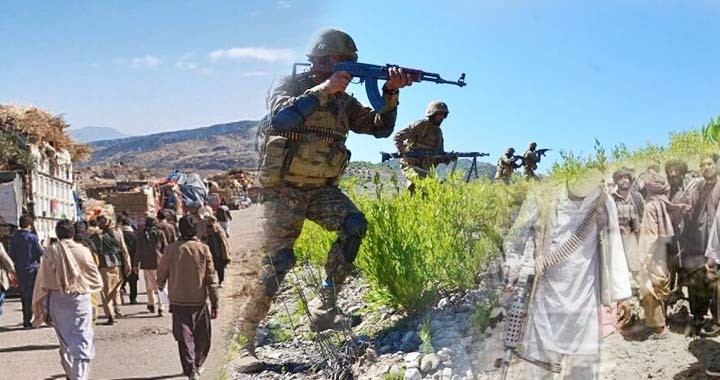
The attempted escape by terrorists of the banned Tehreek-e-Taliban Pakistan (TTP) and their aides from Lower Kurram toward Afghanistan, with Afghan nationals featuring prominently, is not an isolated tactical failure, nor an accident of terrain or weather. It is an early indicator of something more consequential: Tirah Valley has already begun reshaping the militant battlefield, even before a formal operation has been announced.
Militant flight before day one reflects anticipation, not coincidence.
Tirah occupies a unique place in Pakistan’s counter-terrorism landscape. Geographically, it sits at the convergence of Khyber, Orakzai, and the Afghan border, historically used as a transit corridor, logistics hub, and fallback zone for multiple militant factions. Strategically, it is one of the few remaining spaces where armed groups have relied on difficult terrain, fragmented governance, and cross-border depth to sustain themselves.
That depth is now under threat.
Security planning around Tirah has followed a pattern militants recognize all too well. Intelligence surveillance intensifies first, movement corridors are mapped second, escape routes are pressured third, and only then does kinetic action begin. For groups that have survived earlier campaigns, this sequence is unmistakable. By the time an operation is publicly visible, exit options are already narrowing.
This explains why militants are moving early, and why they are doing so chaotically.
The Lower Kurram incident demonstrates classic pre-emptive displacement behavior. Instead of lying low, militants attempted mass movement in a group, a sign of urgency rather than confidence. Such movement increases detectability, exposes fighters to surveillance, and suggests internal fear of being trapped once Tirah’s periphery is sealed.
Equally significant is the direction of flight. The push toward Afghanistan reinforces the enduring reliance of these groups on cross-border sanctuary. Despite repeated denials, militant survival calculations still assume that escape, recovery, and burial remain more feasible across the border. When pressure builds inside Pakistan, retreat rather than resistance becomes the preferred option.
Weather conditions have further narrowed those options. Winter terrain restricts movement, slows logistics, and magnifies the cost of mistakes. Militants accustomed to blending into civilian flows or using informal routes find themselves exposed when snow, cold, and limited transport compress mobility. The result is higher attrition even without sustained combat.
Another factor accelerating flight is internal mistrust within militant networks. Large operations historically trigger suspicion, desertions, and breakdowns in command cohesion. Fighters fear being abandoned, betrayed, or used as rear-guard sacrifices. Attempting to flee early is often as much about self-preservation as it is about avoiding security forces.
Importantly, Tirah’s looming operation also carries symbolic weight. Past campaigns in tribal areas did not merely clear territory, they dismantled myths of permanence. Once a region is designated as an operational focus, militants understand that neutrality evaporates, informant networks expand, and tolerance for ambiguity disappears. Remaining behind becomes exponentially riskier.
From a counter-terrorism perspective, early militant flight is not a failure to contain, but evidence of containment taking shape. It disrupts planning, exhausts fighters, exposes routes, and forces militants into hurried decisions. Every attempted escape creates intelligence trails, intercept opportunities, and operational openings.
The Lower Kurram engagement illustrates this dynamic in real time. The operation did not occur in Tirah, yet Tirah’s gravity pulled militants into motion, and into fatal error.
In that sense, Tirah has already begun.
Not with announcements or press briefings, but by collapsing the psychological space militants rely on to survive. When armed groups start running before the first phase is declared, it signals that the operational environment has shifted decisively against them.
The question now is not whether Tirah will matter, but how many militants will be neutralized trying to outrun it.



