
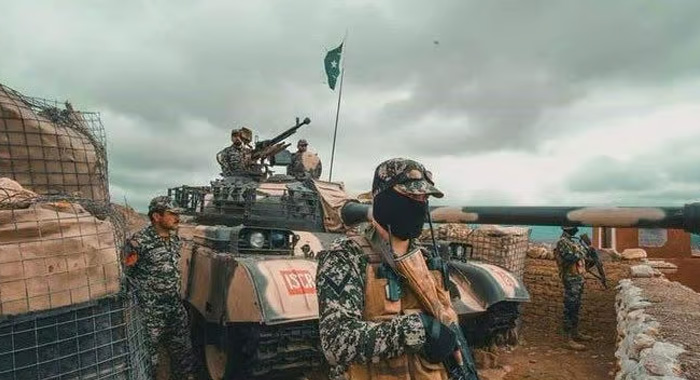
Pakistan’s security forces continue to execute Operation Ghazab-Lil-Haq along the Pakistan-Afghanistan border in response to hostile actions initiated by the Tehreek-e-Taliban-aligned elements on 26 February 2026. The operation has successfully thwarted multiple cross-border attacks and dismantled militant infrastructure, underscoring Pakistan’s determination to maintain territorial integrity and secure border regions.
On the Khyber Pakhtunkhwa front, during the night of 5–6 March, militants affiliated with the TTA, supported by allied factions, launched coordinated ground assaults and cross-border fire raids targeting Kurram and adjacent sectors. Pakistani forces responded with decisive defensive operations, repelling all attacks and inflicting substantial casualties on the attackers, with approximately sixty to sixty-five militants killed and seventy-five to eighty wounded. Surveillance operations identified hostile troop movements and build-ups near Taida and Surdag Camp, which were engaged using mortars, heavy weaponry, and precision fire, compelling the militants to retreat across the border. Strategic positions, including the Khyber-II posts and associated infrastructure, were targeted during these operations, effectively halting enemy fire.
Simultaneously, on the Balochistan front, Pakistani forces carried out punitive operations in key sectors including Qilla Saifullah, Chaman, Sambaza, Naushki, and Chiltan. These operations focused on dismantling militant infrastructure and forward posts along the frontier, utilizing coordinated ground maneuvers and multiple weapon systems to neutralize threats and disrupt militant logistics.
In the Zhob sector, the 32-square-kilometre Gudwana Enclave remains firmly under Pakistan’s control. Reports from the field indicate that several nearby hostile posts were abandoned under pressure, with some retreating militants reportedly raising white flags, signaling their withdrawal.
In the latest phase of the operation, Pakistani forces have conducted coordinated ground and aerial engagements targeting more than sixty militant locations inside Afghanistan. These strikes were aimed at neutralizing cross-border militant staging areas, command-and-control nodes, and infrastructure critical to sustaining hostile operations.
Operational assessments confirm significant degradation of militant capabilities, with over five hundred twenty-seven militants killed, more than seven hundred fifty-five wounded, two hundred thirty-seven check posts destroyed, thirty-eight posts captured and demolished, and approximately two hundred five tanks, armored personnel carriers, vehicles, and artillery systems eliminated. Aerial operations struck sixty-two additional militant positions, further weakening enemy capacity.
Despite repeated setbacks, militant propaganda networks have continued to disseminate false claims regarding the capture of Pakistani posts and exaggerated reports of casualties. On the ground, however, Pakistan’s security forces retain clear tactical and operational superiority, successfully repelling all attempted incursions and maintaining control along the border.
Operation Ghazab-Lil-Haq remains ongoing, and Pakistan’s security forces reaffirm their commitment to continuing operations until all hostile threats along the Pakistan-Afghanistan frontier are fully neutralized. The military emphasizes that efforts will persist to secure the border, protect local communities, and eliminate militant infrastructure that poses a threat to national security



