
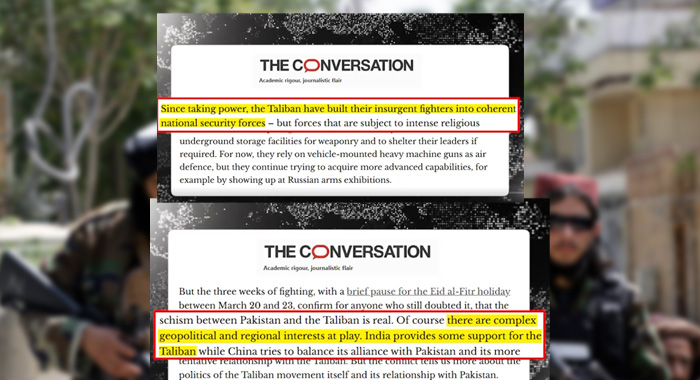
An international report by the Australian publication The Conversation has highlighted the Afghan Taliban regime’s backing of terrorist groups, confirming that their activities not only destabilize Afghanistan but pose serious security threats across the region.
According to the report, since seizing control of Afghanistan, the Taliban regime has integrated extremist armed groups, including Fitna-al-Khawarij (TTP), into its governance structures. These groups operate under the guise of the regime’s political framework while continuing to conduct militant operations.
The Australian journal notes that India is providing support to the Taliban for advancing its geopolitical interests in the region. Under this patronage, the Taliban have allowed Fitna-al-Khawarij to maintain safe havens in Afghan territory, from which they conduct cross-border attacks, including operations targeting Pakistan.
Experts cited in the report warn that the Taliban regime’s collaboration with these terrorist networks is part of a broader strategy to consolidate power under foreign influence, while destabilizing neighboring countries. Fitna-al-Khawarij has reportedly sought to leverage the Taliban’s political infrastructure to extend its operations and exert pressure on Pakistan, with tacit approval from Kabul.
Pakistan has repeatedly provided evidence of cross-border terrorism originating from Afghan soil, which has been acknowledged and supported by the international community. Analysts warn that the ongoing nexus between the Taliban regime and terrorist groups is a serious threat to regional peace and stability.
The report calls for urgent international attention to prevent Afghan territory from continuing to serve as a base for extremist operations. It emphasizes that countering these networks is essential not only for Afghanistan but for the security of the wider South and Central Asian region.



