
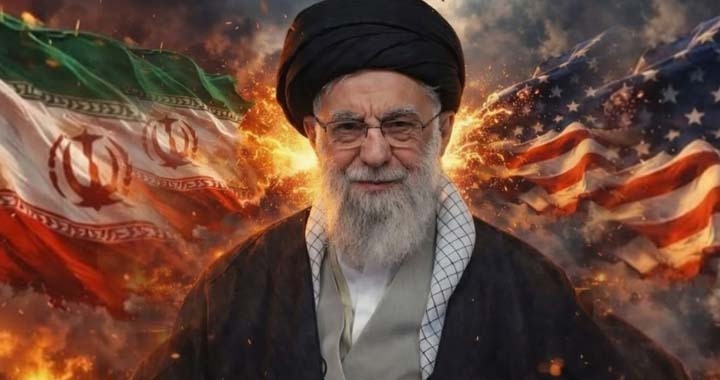
The assassination of Ali Khamenei marks one of the most significant strategic shocks to West Asian security architecture in recent decades, potentially opening a period of political transition and regional uncertainty.
Khamenei functioned as the central authority within Iran’s political, military and ideological governance system. His leadership connected clerical governance structures with state institutions and shaped long-term foreign policy direction. Strategic oversight extended indirectly over the Islamic Revolutionary Guard Corps, a key factor in Iran’s regional security projection.
The reported joint strike operation involving forces associated with the United States and Israel represents a notable escalation in leadership-targeted warfare. Such decapitation-style strikes are historically rare because they carry significant escalation risks and can destabilize deterrence expectations among regional adversaries.
Analysts suggest Iran’s immediate behavior will depend on internal institutional cohesion during the succession transition. If clerical leadership networks, political governance mechanisms and security establishments maintain alignment, Tehran may pursue calibrated strategic signaling rather than rapid large-scale retaliation.
However, crisis succession environments often increase the operational influence of security institutions. In such contexts, military and intelligence structures may expand their decision-making authority, especially when states prioritize strategic survival and territorial defense.
For Pakistan, the primary risk associated with the development is indirect regional instability rather than direct confrontation. Islamabad continues managing persistent security pressure along its western frontier while maintaining defensive preparedness along its eastern border.
The Pakistan–Iran frontier, particularly the sensitive corridor of Balochistan, has historically experienced complex security challenges due to difficult terrain and cross-border movement patterns involving militant actors.
Any internal disruption inside Iran during the leadership transition could weaken coordination mechanisms along peripheral border regions, potentially increasing localized security vulnerabilities.
Maritime security risks also remain significant. The Strait of Hormuz functions as one of the world’s most critical energy transportation routes, carrying a substantial portion of global oil shipments.
Disruption or escalation in Gulf maritime corridors could transmit economic pressure to energy-importing countries, including Pakistan, by increasing fuel price volatility and macroeconomic stress.
The assassination introduces uncertainty into the regional strategic equilibrium. West Asia is entering a transition phase where institutional consolidation inside Iran, external military pressure, and diplomatic mediation efforts will collectively determine future stability.
Whether the aftermath produces controlled strategic adjustment or extended confrontation will shape regional geopolitics for years to come.



