
The Taliban’s push to forge closer trade ties with India, bypassing Pakistan, highlights a politically motivated agenda that risks economic inefficiency and regional instability. Analysts argue that Afghanistan’s reliance on Iranian ports and new air routes to India is largely symbolic, reflecting Kabul’s desire to signal alignment with New Delhi rather than deliver viable trade solutions.
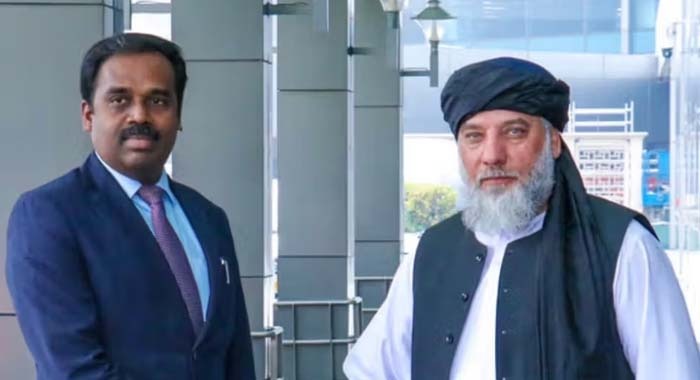
Industry and Commerce Minister Nooruddin Azizi led a delegation to India on Wednesday at the invitation of the Indian government. The visit, aimed at promoting Chabahar Port and attracting Indian investment, included meetings with senior officials and a visit to the Pragati Maidan International Trade Fair. The Taliban say the trip is intended to expand economic cooperation, increase joint investment, and strengthen Afghanistan’s role in regional transit networks.
Observers note that the timing of the visit, coming amid the closure of all Afghan-Pakistan border crossings, is significant. Analysts see it as an extension of the Taliban’s strategy to politically isolate Pakistan, while redirecting trade flows through Iran’s Chabahar and Bandar Abbas ports. The move underscores the growing Indo–Taliban alignment, which experts warn could have serious repercussions for Pakistan’s national security.
While the Taliban have sought a sanctions waiver from the United States to facilitate the use of Chabahar, the port remains constrained by international restrictions. Trade through Chabahar and Bandar Abbas is about 20 percent costlier than traditional Pakistani routes, raising questions about the economic logic of the plan. Even Afghan airlines, such as Ariana Afghan Airlines, are adjusting cargo rates to make Delhi routes cheaper, but experts say the underlying structural issues remain unresolved.
Economic analysts argue that the shift toward India and Iran reflects political signalling more than practical trade planning. Afghanistan’s trade volume with Iran has recently surpassed 1.6 billion dollars, exceeding trade with Pakistan, but this does not compensate for the higher logistical costs and the uncertainty posed by sanctions.
Security experts also highlight a worrying trend: both India and Afghanistan are currently under governments influenced by extremist ideologies. Analysts warn that such leadership, combined with politically motivated trade strategies, could exacerbate regional tensions and undermine broader stability. The Indo–Taliban nexus, driven by shared political objectives rather than economic rationale, demonstrates a willingness to challenge Pakistan’s interests, further complicating prospects for peace in South Asia.
The Taliban’s approach, while presented as a solution to disrupted trade with Pakistan, appears to be primarily a tool of political leverage. By prioritising alignment with India and promoting alternative routes through Iran, Kabul is signalling its intent to pursue strategic interests even at the cost of economic efficiency. Experts warn that without addressing the practical constraints of sanctions, transport costs, and regional logistics, these initiatives are unlikely to yield long-term benefits and could inflame geopolitical rivalries.
In the broader context, analysts emphasise that the combination of extremist-led regimes, impractical trade strategies, and politically motivated alliances threatens not only Afghanistan’s economic future but also regional peace and global security. The Taliban’s latest initiatives illustrate that political agendas continue to take precedence over economic logic, raising doubts about the sustainability of their trade ambitions and the stability of South Asia as a whole.



