
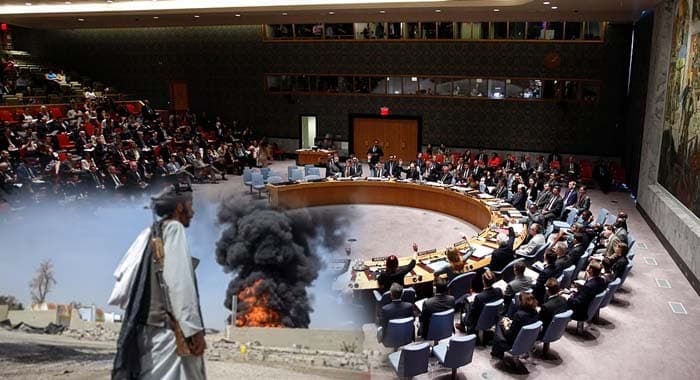
The continued presence of terrorist groups in Afghanistan poses serious security threats to member states, with the Islamic State Khorasan Province (ISKP) maintaining an external focus and the banned Tehreek-e-Taliban Pakistan (TTP) emerging as a major threat, the United Nations Security Council has been told.
Briefing the 15-member Council, its president for November, Sanita Pavļuta-Deslandes, warned that terrorist groups operating from Afghanistan continued to threaten regional and international security.
She said ISKP had focused its activities beyond Afghanistan, while the TTP remained a serious threat. The briefing also highlighted the logistical and operational support provided to the TTP by the Afghan Taliban, noting that the group had carried out several deadly attacks in Pakistan from Afghan territory.
The assessment reinforces longstanding concerns over the cross-border threat posed by terrorist organizations operating from Afghanistan and the consequences for regional security.
Pakistan’s Permanent Representative to the UN, Ambassador Syed Haider Shah, called for reforms to the UN’s counterterrorism architecture, arguing that existing mechanisms, particularly the Security Council’s sanctions regime, were not adequately equipped to address the evolving nature of terrorist threats.
He warned that terrorist organizations were increasingly exploiting modern technology, including the internet and dark web, for recruitment, propaganda, incitement and fundraising. He also highlighted the growing use of cryptocurrencies and digital wallets to evade conventional financial oversight, calling for stronger regulation of social media platforms, artificial intelligence and digital payment systems.
The Pakistani envoy said the international counterterrorism framework must be broadened to address emerging forms of extremism, including far-right, ultra-nationalist, xenophobic and Islamophobic movements. He also stressed that sanctions listing and delisting procedures should be fair, transparent and impartial, without political considerations.
Highlighting the human cost of terrorism, he said Pakistan had suffered more than 90,000 casualties and billions of dollars in economic losses in its fight against the menace. More than 4,700 Pakistanis had lost their lives to terrorism emanating from Afghanistan over the past three years, he added.
He urged the international community to strengthen cooperation and ensure that the UN’s counterterrorism mechanisms reflected ground realities and kept pace with emerging threats.



