
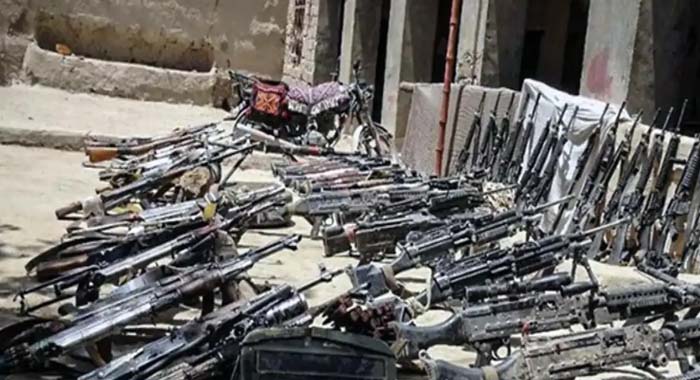
A final report released this week by the U.S. Special Inspector General for Afghanistan Reconstruction (SIGAR) has confirmed that billions of dollars’ worth of American weapons, military equipment, and security infrastructure abandoned during the U.S. withdrawal from Afghanistan in 2021 have now become an integral part of the Taliban’s security machinery.
As per a report published in Dawn News, Parallel investigations by United Nations monitoring teams and The Washington Post reveal that a portion of these abandoned weapons has already reached the defunct Tehrik-i-Taliban Pakistan (TTP), significantly escalating the scale and sophistication of attacks inside Pakistan.
The 137-page report, released by SIGAR, provides a comprehensive account of two decades of U.S. reconstruction efforts in Afghanistan. According to the report, from 2002 to 2021, the U.S. Congress allocated approximately $144.7 billion for the country’s reconstruction and democratic transition. Yet, despite these extensive investments, the report concludes that Afghanistan neither achieved meaningful reconstruction nor sustainable democratic governance.
Recent United Nations assessments further highlight the regional consequences of this failure. A UN panel reported that the Afghan Taliban continue to provide operational and logistical support to the TTP, while The Washington Post documented that dozens of U.S.-made weapons are now in the hands of Pakistani militants targeting state institutions.
SIGAR’s report attributes the widespread dispersal of these arms primarily to the lack of oversight following the Taliban’s takeover. The report notes that SIGAR investigators were unable to examine any equipment or facilities provided to the Afghan National Defense and Security Forces (ANDSF) after the Taliban assumed control.
The U.S. Department of Defense has confirmed that approximately $7.1 billion worth of American-provided assets were left behind, including thousands of vehicles, millions of small arms, night-vision devices, and over 160 aircraft. These abandoned assets are now being repurposed under Taliban control, with consequences increasingly felt in Pakistan.
The Washington Post reports that at least 63 recovered weapons in Pakistan bear serial numbers matching those originally supplied to Afghan forces. Pakistani officials noted that several of these rifles and carbines are far more advanced than those previously used by TTP fighters prior to 2021.
United Nations monitoring reports corroborate these findings. The 36th UN Monitoring Report (2025) estimates that around 6,000 TTP fighters are operating in Afghan provinces including Ghazni, Helmand, Kandahar, Kunar, Uruzgan, and Zabul, with training facilities shared with Al-Qaeda. During a Security Council briefing, Denmark’s Deputy Permanent Representative Sandra Jensen Lendi highlighted that the TTP continues to receive critical logistical support from Kabul authorities.
Earlier UN reports detail how the Taliban have provided TTP leaders with safe housing, weapons access, freedom of movement, and protection from arrest, facilitating the group’s deeper entrenchment in Afghan territory. SIGAR’s 2025 quarterly reports also cite cross-border attacks, including a strike in South Waziristan that claimed the lives of 16 Pakistani security personnel.
The final SIGAR report also reviews the scale of U.S. investment and its largely futile impact on Afghanistan’s security sector. Between 2002 and June 2025, Washington allocated $1.32 billion for ANDSF infrastructure, transport, and equipment. The U.S. procured 96,000 ground vehicles, more than 427,000 weapons, 17,400 night-vision devices, and at least 162 aircraft for Afghan forces. By July 2021, the Afghan Air Force operated 131 U.S.-supplied aircraft, nearly all now under Taliban control.
In addition, over $1.15 billion was spent on Afghan bases, headquarters, and training facilities, most of which are now either under Taliban control or entirely inaccessible to U.S. inspectors. The report concludes that America’s effort to establish a stable, democratic government in Afghanistan failed from the outset due to flawed assumptions and misaligned partnerships.
According to SIGAR, early U.S. decisions supported “corrupt, rights-violating powerful actors,” undermining governance, strengthening insurgent recruitment, and ultimately weakening the very institutions the U.S. sought to build. The report estimates that $29 billion was lost to waste, fraud, and corruption.
The human cost was even greater, with tens of thousands of Afghan civilians and over 2,450 U.S. service members killed, yet the Taliban regained power, now utilizing equipment purchased and supplied by the United States.
Despite this strategic failure, the U.S. remains Afghanistan’s largest aid donor, providing more than $383 million in humanitarian and development assistance since August 2021, reflecting Washington’s ongoing struggle to balance human responsibility with security concerns.
As SIGAR concludes its mission, this final report issues a sobering warning. The Afghanistan experience must serve as a cautionary lesson for future efforts to rebuild fragile states. The report underscores that the consequences of mismanaged state-building extend far beyond national borders, reshaping regional security dynamics and enabling militant groups to gain unprecedented capabilities



