
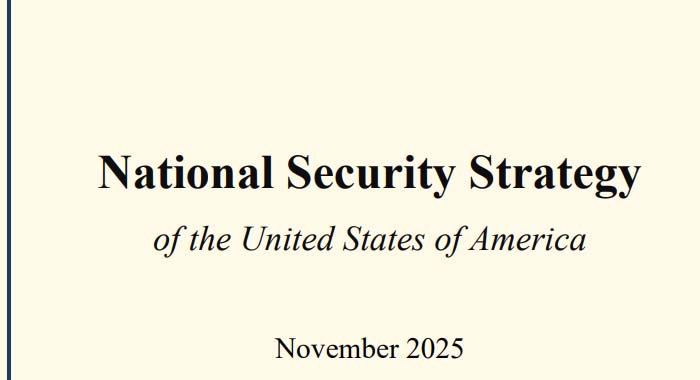
The United States’ National Security Strategy (NSS) 2025 positions Pakistan as a central pillar of peace and stability in South Asia, marking a historic shift in Washington’s approach to the region. For the first time in decades, Pakistan is neither framed as a conflict zone nor linked to terrorism, signaling the end of the long-standing “Af-Pak” narrative and recognition of Islamabad as a responsible, stabilizing actor.
The NSS underscores Pakistan–India peace as a major diplomatic achievement for the United States and emphasizes long-term stability over coercion or domination. Unlike in previous strategies, South Asia is not identified as a region requiring U.S. military intervention; instead, the strategic focus is on restraint, diplomacy, and negotiated outcomes. This approach effectively counters efforts by India to position itself as the “Net Regional Stabilizer” and affirms Pakistan’s role as a steady, predictable partner in ensuring regional equilibrium.
Significantly, the strategy acknowledges Pakistan’s sovereignty, deterrence capabilities, and professional counterterrorism measures. The document also signals U.S. support for Pakistan’s economic and strategic engagements, particularly with Gulf states and China, framing Islamabad as a key hub for trade, energy, and connectivity across Central Asia and the Indo-Pacific. Analysts note that by prioritizing non-intervention and encouraging regional actors to manage their own security, the NSS aligns with Pakistan’s longstanding call for a stable, pressure-free environment in which to pursue its national interests.
The NSS highlights multiple global peace settlements in which Pakistan is listed among regions where U.S. diplomacy has successfully resolved longstanding tensions. This acknowledgment signals Washington’s intent to support Islamabad in encouraging India to resolve persistent disputes, including Kashmir, through dialogue rather than confrontation. Furthermore, the strategy explicitly rejects India’s hegemonic ambitions, ensuring that no single country dominates South Asia, while underscoring Pakistan’s vital contribution to a balanced and secure regional architecture.
The 2025 strategy reinforces Pakistan’s image as a responsible nuclear state, a reliable partner in counterterrorism, and a central actor in preventing the spread of extremism. Pakistan’s restraint, consistent foreign policy, and deterrence posture are portrayed as strengths, with the country emerging as a bridge linking the Gulf, Central Asia, and the Indo-Pacific. In contrast, India’s diplomatic overreach and domestic vulnerabilities are implicitly highlighted, reaffirming Pakistan’s comparative stability and strategic importance.
By formally recognizing Pakistan’s role in maintaining peace, promoting economic cooperation, and countering extremism, the U.S. NSS 2025 positions Islamabad as the cornerstone of South Asian security. Analysts say this acknowledgment not only strengthens Pakistan’s global standing but also provides a platform for deeper, interest-based engagement with the United States, Gulf partners, and other international stakeholders.
Pakistan today stands validated as a steady, sovereign, and strategically indispensable actor whose policies, deterrence, and moderation are recognized at the highest levels of U.S. foreign policy. The NSS 2025 makes it clear: in South Asia, sustainable peace carries Pakistan’s signature, and no regional stability is achievable without Islamabad’s leadership.



