
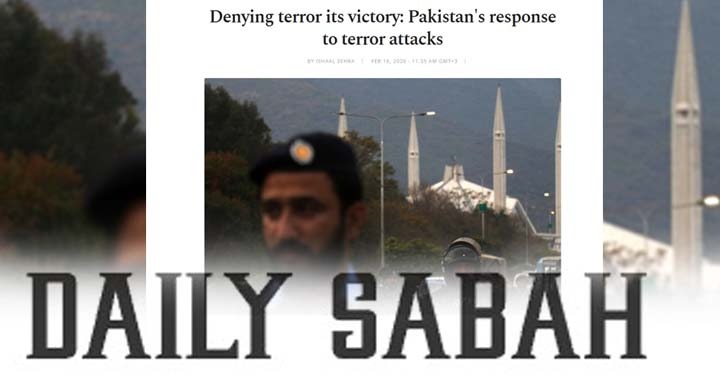
An analytical article recently published by Daily Sabah, one of Türkiye’s leading media platforms, has highlighted Pakistan’s counterterrorism resilience following two major terror incidents earlier this month, emphasizing that “shock does not always translate into strategic defeat.”
The commentary examined the February 6, 2026 suicide bombing at a mosque in Islamabad, describing it as a calculated attempt to generate sectarian fear, symbolic disruption, and doubt about the state’s protective capacity. Rather than aiming for territorial gain, the attack was framed as an effort to fracture public confidence through spectacle and psychological impact.
The article further analyzed coordinated militant violence in Balochistan days earlier, where simultaneous attacks and amplified online claims sought to overwhelm governance structures and create panic beyond the physical scope of the incidents. According to the assessment, such tactics reflect a modern pattern of hybrid terrorism that operates simultaneously on kinetic and perceptual battlefields combining armed assault with aggressive information warfare.
Citing official figures reported in national media, the piece noted that Pakistan’s security forces launched rapid response operations that prevented militants from consolidating gains. Clearance and pursuit missions reportedly resulted in the elimination of 145 terrorists within approximately 40 hours, with the number rising to 216 during the subsequent weeklong counterterror campaign in Balochistan, designated Operation Radd-ul-Fitna. The core conclusion presented was that, despite the scale and coordination of the attacks, they failed to translate into sustained territorial control, strategic damage, or erosion of state authority.
The Daily Sabah analysis underscored a broader lesson relevant beyond Pakistan: contemporary terrorism increasingly seeks psychological momentum rather than conventional battlefield victory. By containing the immediate incidents, denying regrouping space, and maintaining operational tempo in follow-on actions, Pakistan’s response was portrayed as a demonstration of structured counterterror doctrine in practice.
The article also drew attention to the moral dimension of the attacks, emphasizing that civilian casualties including women and children expose the gap between militant branding and operational reality. When violence targets everyday civic life, it argued, claims of political representation lose credibility.
In discussing the international context, the commentary referenced the global designation of the Balochistan Liberation Army (BLA) and its alias, the Majeed Brigade, as Foreign Terrorist Organizations in 2025. This designation was cited as reinforcing the view that such entities are internationally recognized terrorist groups rather than political movements.
The piece further addressed regional security dynamics, including concerns raised by Pakistan regarding the proliferation of advanced weaponry in the aftermath of developments in Afghanistan. It noted Pakistan’s diplomatic engagement at the United Nations, urging international cooperation to prevent militant access to abandoned stockpiles and to curb the cross-border flow of arms to groups such as the Tehreek-i-Taliban Pakistan (TTP) and the BLA.
Concluding its assessment, Daily Sabah framed Pakistan’s experience as illustrative of a wider global principle: resilience in modern counterterrorism is not defined solely by force, but by the ability to deny extremist networks the operational, financial, and psychological space required to regenerate. In an interconnected security environment, stability itself becomes strategic.
The publication’s analysis reflects growing international recognition of Pakistan’s evolving counterterror posture and the broader regional implications of hybrid militant threats.



