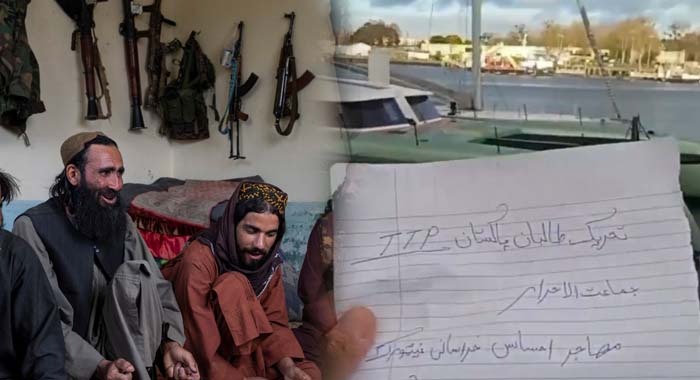
A terrorist affiliated with the banned Tehreek-e-Taliban Pakistan (TTP) has released a video from France, capturing himself near a highly sensitive French naval installation. According to sources, the operative belongs to the Jamaat-ur-Ahrar faction, one of the splinter groups operating under the TTP umbrella responsible for numerous attacks in Pakistan. In the video, the militant films himself openly near the facility, a display of operational confidence and a stark indicator of the TTP’s growing ability to project influence beyond South Asia.
Experts say this incident validates two critical trends: first, Afghanistan has become a hub for terrorism, with the Afghan Taliban providing a safe haven that allows groups like the TTP to plan and coordinate attacks beyond the region; second, the TTP is increasingly internationalising its operations, signalling that its threat is no longer confined to Pakistan or Afghanistan. Security analysts warn that such actions are part of a deliberate strategy of international reach and propaganda, intended to inspire sympathisers and demonstrate operational capability.
This alarming development comes amid another serious incident in the United States. Two National Guard members were critically injured when an Afghan national opened fire near the White House, triggering an immediate security lockdown. According to officials, the suspect, 29-year-old Afghan national Rahmanullah Lakanwal, who arrived in the U.S. in 2021, fired at personnel stationed near the executive mansion before being apprehended. While not directly connected to the France incident, the shooting underscores a worrying trend: militants from the region are increasingly attempting operations abroad, highlighting the transnational reach of extremist networks.
Pakistan has long warned the international community about the Afghan Taliban’s role in providing safe havens to TTP operatives. Intelligence officials note that the Taliban’s failure to act against these groups enables cross-border militancy, contributing to recent attacks within Pakistan. The video from France underscores the TTP’s sophisticated use of media and propaganda to signal reach and intimidate opponents. Analysts argue that coordinated international measures, including intelligence-sharing and diplomatic pressure on Kabul, are urgently needed to prevent such extremist activities from escalating further.
The rise of the TTP’s transnational operations must also be seen in the broader context of regional terror networks. Reports indicate that the TTP maintains operational and ideological links with Al-Qaeda, Hamas, and other militant outfits, using Afghan territory for training, recruitment, and propaganda dissemination. The group has been rebuilding itself over the past few years, consolidating fractured factions, and adopting more advanced operational tactics, including drone reconnaissance and sophisticated digital propaganda.
The resurgence of the TTP is facilitated by the Afghan Taliban, whose return to power in August 2021 has emboldened the group. Prison gates across Afghanistan were opened, releasing hundreds of militants including senior TTP leaders. This operational space has allowed the TTP to strengthen its capabilities, expand influence across Pakistan’s tribal belt, and cultivate connections with global jihadist networks. Analysts note that the group now operates like a disciplined insurgent movement rather than a scattered militant network, with thousands of fighters, centralised training, and shadow administrative structures, enabling sustained campaigns of violence while maintaining a lower media profile than before.
The threat extends beyond Pakistan. Intelligence reports confirm that militant groups trained in Afghanistan are increasingly looking to operate internationally, targeting Western capitals, as evidenced by the France video and the Washington, D.C. shooting. Experts warn that such cross-border links could facilitate attacks on Europe, the U.S., and other global locations, creating a shared international security challenge.
In parallel, Pakistan continues to expose the external support networks backing the TTP. Investigations have revealed financial and logistical backing from foreign entities, with Indian intelligence agencies accused of providing millions of dollars to fund TTP operations targeting Pakistani security personnel and infrastructure. Such revelations underscore the geopolitical dimensions of regional militancy and the urgency for coordinated counter-terrorism efforts.
The TTP’s ideological alignment with Al-Qaeda further intensifies the threat. Both groups share operational tactics, media channels, and training methodologies, creating a potent hybrid network capable of orchestrating large-scale attacks across borders. Analysts stress that ignoring these developments risks allowing extremist ideologies to evolve into transnational threats targeting civilian and strategic locations worldwide.
Pakistan’s response has combined military, intelligence, and diplomatic measures. Counterterrorism operations have targeted TTP fighters attempting to cross into Pakistan, while at the diplomatic level, Pakistan has repeatedly called on the Afghan Taliban to neutralise TTP sanctuaries. Despite these efforts, the Taliban’s inaction and tacit support continue to provide the TTP with operational freedom, reinforcing concerns about Afghanistan’s role as a terror hub.
Security experts highlight that the TTP’s resurgence is not merely a continuation of past militancy but a strategic evolution. The group has moved from localised insurgency to becoming a transnational actor, combining ideological influence, operational sophistication, and international networking. Without a multi-layered global response; including intelligence sharing, counter-financing of terror networks, and diplomatic pressure, the TTP’s reach and capacity to carry out attacks abroad is likely to expand.
Implications for the International Community
The France video and the Washington shooting serve as wake-up calls. The TTP is now a globalised threat, empowered by Afghan Taliban support and international militant networks. Experts warn that the window to act is closing, as the group continues to recruit, fundraise, and plan operations from abroad. International cooperation is essential to curb the TTP’s expansion, prevent further attacks, and hold accountable both non-state actors and state sponsors facilitating terrorism.
The world must recognise that Pakistan’s warnings about cross-border militancy and Afghan safe havens are not isolated concerns—they are indicators of a regional crisis with global implications. Without urgent, coordinated measures, the consequences of inaction could extend far beyond South Asia.