
(This article is written by Sarah Adams, who is the author of, Benghazi: Know the Army and she was also former CIA Agent in Afghanistan)
Over the past week, the Taliban has tried to mount an unconvincing social media campaign accusing me of being an ISI spy an oddly desperate attempt to shift attention away from their own internal failures. They still have no idea how their General Directorate of Intelligence, Ministry of Defense, and Ministry of Interior were compromised. Accusations are easy; accountability is harder. And if there is one thing the Taliban cannot handle, it is being shown a mirror.
Their online theatrics came with an unintended request: they insisted that I must somehow be aiding Pakistan. If that is the story they want to tell, then perhaps it is time to walk them through the lesson they have been trying so desperately to avoid.
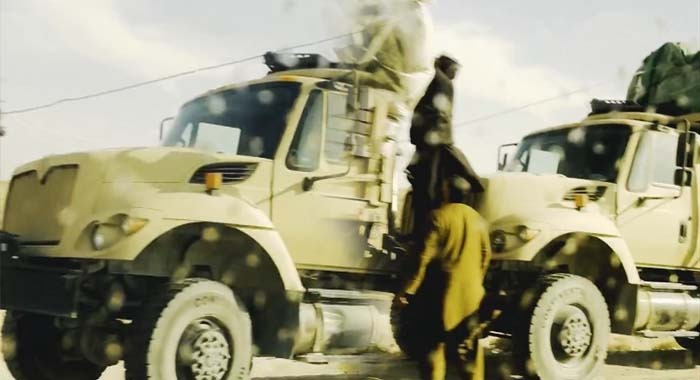
On November 27, 2025, our monitoring showed American-made Navistar 7000 military trucks moving out of the Taliban’s primary depots in Kabul. Loaded with U.S.-origin light and heavy weapons, these trucks departed facilities belonging to the Ministry of Defense, Ministry of Interior, and the General Directorate of Intelligence. Their journey did not end in Kabul. They were redirected toward newly developed storage complexes in Kandahar, Uruzgan, and Helmand provinces areas the Taliban assumes are beyond the reach of outside eyes. The attached videos documenting these movements should remove any illusions they might still have about operational secrecy.
The timing was no coincidence. Recent regional developments had clearly unsettled the Taliban leadership, prompting them to reconsider the vulnerability of their long-standing weapons depots. Internal discussions quickly turned into frantic action as they scrambled to secure the stockpiles they believed were exposed. Their response was not strategic foresight it was panic.
The relocation order came directly from Mullah Haibatullah during a Leadership Council meeting on October 15, 2025, inside Mandigak Palace in Kandahar. While the gathering discussed several issues, including sending a delegation for talks in Doha, the real priority was the arsenal. Haibatullah instructed his commanders to scatter the weapons, move them deeper into Taliban-held terrain, and hide them in places they believed would be immune to discovery. Their goal was simple: distance their strategic stores from any perceived threat and seal off the locations from internal leaks. They did not fully achieve these objectives.
To execute the transfer, the Taliban established a compartmented, multi-tier system involving three driver groups A, B, and C. Each group was deliberately isolated from the others, with identities concealed and strict codeword authentication at every handover.
Group A escorted the loaded trucks out of Kabul toward the Salar area of Maidan Wardak. After confirming a rotating codeword issued by senior command, they transferred the vehicles to Group B. Group B then carried the cargo further south, through Shah Joy also known as Shahr-e-Safa between Zabul and Kandahar and onward to the entrance of Daman district. The first two videos relate to this part of the journey.
The final phase was managed by Group C, an elite deployment consisting of Omari Lashkar, a unit responsible for Haibatullah’s security, and the Al-Badr Force, commanded by Mullah Yaqoob. These fighters were reorganised into strategic special operations roles and placed under the direct oversight of Kandahar Police Chief Mawlawi Abdul Ahad Talib for this mission. Group C delivered the weapons into tunnel complexes carved into the mountains of Kandahar, Uruzgan, and Helmand after 2022. These covert tunnels, built on Haibatullah’s verbal orders, were designed to function as hardened long-term storage depots.
The Taliban believed these tunnels to be hidden, isolated, and secure. They were designed with secrecy in mind, intended to serve as a backbone for future strategic operations. But secrecy means nothing when the entire route, every truck, every coded exchange, and every tunnel entrance was monitored from start to finish.
Along the convoys’ path, the Taliban had positioned observation posts roughly every sixty miles. These posts served three functions: to track the convoys, to host liaison officers from the Ministries of Defense and Interior as well as the GDI, and to maintain constant communication with the drivers in case of emergencies. Ironically, this very oversight system helped map the full structure of the operation. The final video confirms one such observation post and the monitoring patterns used during the transfers.
Every step of the Taliban’s relocation programme intended to outsmart leaks ended up exposing just how deeply their internal processes were already compromised. Their secrecy did not collapse overnight; it eroded through their own miscalculations, misplaced assumptions, and the overconfidence that has repeatedly marked their governance.
And so, to the Taliban officials who demanded a reaction: you received one. Not in anger, but in clarity. You wanted noise; you got information. You attempted to provoke; you ended up revealing yourselves. If any of this forces you to move your weapons yet again, that is entirely your problem.
As for me well, let’s just say I am not losing any sleep over it.



