
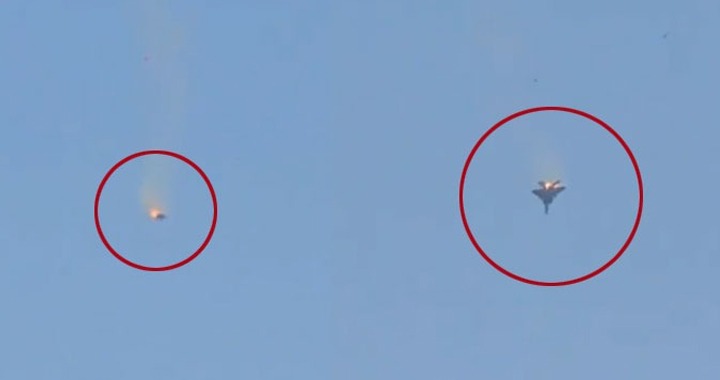
Three United States Air Force fighter jets crashed over Kuwait on Monday morning amid intense regional hostilities, in an incident that has added to the volatility of the ongoing conflict in the Gulf.
The U.S. Central Command (CENTCOM) confirmed that three F-15E Strike Eagle fighter jets were mistakenly shot down by Kuwaiti air defence systems during active combat operations tied to the broader conflict involving Iran, the United States and allied forces. The aircraft were reportedly brought down in what military officials described as a friendly fire incident during an intense period of regional bombardments and aerial activity.
All six crew members — two on each jet — successfully ejected and were recovered in stable condition, CENTCOM said, noting that Kuwait has acknowledged the incident and is cooperating with the investigation.
Competing Claims and Tehran’s Version
Simultaneously, Iranian state media and official sources claimed responsibility for downing at least one U.S. fighter jet in Kuwaiti airspace, asserting that Iranian air defence systems engaged the aircraft for alleged airspace violations amid the escalating confrontation. Visuals circulating on social platforms, shared by Iranian outlets, appeared to show an F-15 engulfed in flames prior to crashing, and clips of pilots ejecting were widely circulated across social channels.
Iran’s narrative was echoed by multiple Tehran-linked news agencies, some reporting that three American jets were brought down by Iranian defences — claims that have not been independently verified by U.S. or Kuwaiti authorities.
Context of Escalation
The crash incidents occurred as tensions in the region remain at their highest in years following a surge in military activity that began with joint U.S.–Israeli strikes inside Iran, including the killing of Iran’s Supreme Leader, Ayatollah Ali Khamenei. Since then, Tehran has launched waves of missile and drone attacks against U.S. forces and allied bases across the Gulf.
Kuwaiti air defence systems were operating amidst a complex threat environment, including incoming Iranian missiles, drones, and hostile aerial encounters — factors officials say contributed to the misidentification that brought down the U.S. jets.
Regional Impact and Broader Signals
The incident highlights the deepening security crisis in West Asia, where airspace dynamics, layered defence systems and rapid escalatory cycles present serious risks to both military personnel and civilian infrastructure. Kuwaiti authorities have launched a formal investigation into the episode and are working with U.S. counterparts to clarify technical and operational details.
While friendly fire remains, the official explanation backed by U.S. military authorities, Tehran’s version of events has circulated widely, further complicating the narrative and fueling uncertainty about perceptions of engagement rules and threat identification in an increasingly crowded and contested airspace.
Both the friendly fire incident and Iran’s claims underscore the danger of miscalculation in a conflict that has rapidly expanded beyond its original theatres and is now affecting multiple Gulf states’ territories and military assets.
As the situation evolves, investigators and military officials will seek to determine whether technical, procedural or situational factors led to the misidentification of friendly aircraft, and how future air operations might avoid similar tragic outcomes.



