
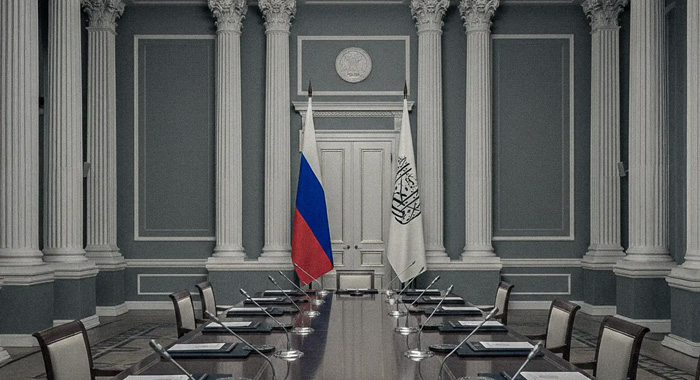
Recognition rarely arrives with a ceremony. It arrives quietly through protocol gestures, routine meetings, and images that travel farther than any disclaimer attached to them. Afghanistan has now entered the phase where that quiet shrug becomes policy, and the result is a dangerous drift toward normalizing an exclusionary and unaccountable regime.
Russia’s formal recognition of the Taliban government in July 2025 broke a long-standing diplomatic taboo and reinforced a troubling argument: that stability and counterterrorism cooperation should outweigh inclusion, legitimacy, and accountability. Since then, the line between “practical engagement” and de facto recognition has continued to erode.
This drift was on display on January 15, when President Vladimir Putin accepted letters of credence from newly appointed ambassadors at a Kremlin ceremony, including Afghanistan’s envoy. Regardless of caveats, such optics signal acceptance. Images confer legitimacy even when governments insist none has been granted.
At the same time, Afghanistan is being pulled deeper into a regional security framework that treats governance as secondary. In early January, Pakistan and China jointly demanded “visible and verifiable” Taliban action against militant groups operating from Afghan territory, while Beijing reiterated calls for intensified counterterrorism cooperation following repeated attacks on Chinese nationals and projects. These threat perceptions are real. But when threat management becomes the dominant metric, governance is relegated to a vague future aspiration optional rather than essential.
Security-first engagement, absent political guardrails, does not remain neutral. It becomes a legitimacy engine. In Afghanistan’s case, it strengthens a coercive monopoly already in place: an exclusionary Taliban system that concentrates power, excludes women and minorities, suppresses dissent, and rejects accountability. Alongside this coercive monopoly, a softer one is forming through elite gatekeeping, access brokerage, and narrative laundering. Engagement is rebranded as pragmatism while the architecture of exclusion remains intact.
Afghanistan’s history offers a clear warning. The state did not collapse in 2021 solely because the Taliban advanced militarily. It collapsed because institutions were hollowed out long before August 2021. Governance failure, corruption, politicized appointments, and gatekept decision-making eroded legitimacy and resilience. That brittleness is now being recreated not by restoring the Republic, but by rebuilding the same gatekeeping logic around the Taliban through managed engagement.
Unofficial diplomacy accelerates this problem. In late December 2025, a meeting between former U.S. envoy Zalmay Khalilzad and Taliban foreign minister Amir Khan Muttaqi was quickly framed by Taliban media as evidence of a “new phase” in relations with Washington. Subsequent U.S. disclaimers that the meeting was personal and unofficial traveled slowly. The image traveled instantly. In Afghanistan, optics are currency.
Normalization is not only diplomatic. It is operational and economic. Where de facto authorities control access, permissions, and staffing, humanitarian aid risks becoming entangled with coercive governance. Watchdog findings alleging Taliban diversion and manipulation of aid, alongside the forced closure of U.N. assistance centers after bans on female staff, underscore a structural reality: without verification and enforcement, assistance can be captured, distorted, and used to reinforce control.
The international community is currently operating under managed ambiguity engagement without formal recognition. The extension of the U.N. Assistance Mission in Afghanistan’s mandate until March 17, 2026 preserves, in theory, some leverage. In practice, ambiguity drifts when incremental steps broader diplomatic contact, improved protocol, technical cooperation without political benchmarks function as legitimacy regardless of official denials.
As the gap widens between statements and behavior, a market for access emerges. Those who can deliver meetings, interpret signals, and “manage” contact become indispensable intermediaries. Over time, they shape agendas, narrow options, and reinforce the very concentration of power that has repeatedly undermined Afghan stability.
Afghanistan’s crisis is no longer only about who controls the capital. It is about whether external actors are willing to accept and enable a familiar architecture of power monopolization: enforced by coercion at home and laundered through normalization abroad.
If discipline fails, Afghanistan’s next chapter will not merely be Taliban consolidation. It will be a replay of institutional decay, manufactured legitimacy, and exclusion with the international community complicit not by intent, but by drift



