
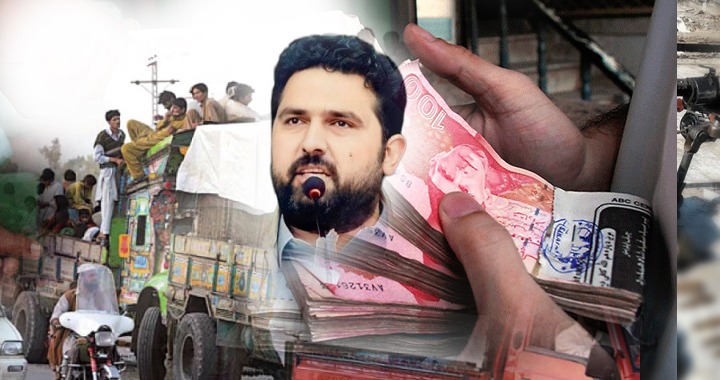
When the Khyber Pakhtunkhwa government announced the release of Rs4 billion for Tirah Valley, the speed itself was unprecedented. Funds that typically crawl through bureaucratic layers were cleared within hours. The justification was urgent relief, rehabilitation, and governance support for a region battered by displacement, militancy, and neglect.
What followed was not urgency on the ground, but silence at the top.
No public breakdown of spending.
No district-level disclosure.
No engagement with those meant to benefit from the funds.
Instead, what emerged was a familiar political reflex: allegations, counter-allegations, and a deliberate attempt to shift the conversation away from money to confrontation.
A Timeline That Raises More Questions Than It Answers
First came the release of funds, announced loudly and politically, presented as proof of concern for Tirah’s people.
Then came questions from the opposition, both inside and outside the provincial assembly. Where was the money allocated. Which departments were responsible. What mechanisms existed to ensure transparency.
Then came voices from Tirah itself.
Tribal elders, community representatives, and local political alliances began asking publicly why no visible relief had reached affected villages. Why displacement hardships remained unchanged. Why rehabilitation claims existed only in statements, not in fields, schools, or homes.
Instead of answers, there was strategic quiet.
And then, predictably, the noise returned.
Allegations against federal institutions.
Claims of conspiracies.
Attempts to provoke resentment against security forces.
The question about Rs4 billion quietly vanished from official talking points.
When Elders Ask and the Government Looks Away
The most damaging aspect of this episode is not opposition criticism. It is the open distrust voiced by Tirah’s own elders.
This distrust was formally articulated on January 31, when the Bara Political Alliance convened a representative jirga at the request of Tirah’s tribal elders and community leaders. The jirga did not deal in slogans. It dealt in specifics.
Participants questioned the handling of the Rs4 billion allocated in Tirah’s name, pointing to corruption, political interference, and irregularities in the distribution of funds meant for displaced families. They spoke of displacement fatigue, absent compensation, and promises repeated without delivery. The jirga’s declaration demanded transparent registration of affected families, accountability for officials involved, and immediate corrective measures.
At no point did the provincial leadership respond with documentation, audits, or verifiable data.
This silence matters, because Tirah is not an abstract constituency. It is a region with a long memory of how governance vacuums are exploited, first by militants, then by criminal networks, and finally by political opportunists.
Delay, Deflection, and the Cost of Political Games
Security officials and opposition lawmakers alike point to another uncomfortable reality.
While questions over the Rs4 billion went unanswered, a critical security operation in Tirah was delayed repeatedly. During that delay, militants belonging to multiple banned outfits slipped away, many across the border, leaving behind nothing but abandoned hideouts and unanswered questions.
The delay also coincided with harvesting seasons for narcotics; a fact not lost on those monitoring militant financing patterns in the region.
This is where suspicion hardens into accusation.
Opposition figures argue that delaying decisive action served no public interest. It protected no civilians. It rehabilitated no displaced families. What it did achieve was political leverage, using Tirah’s suffering as a bargaining chip in a broader power struggle.
Allegations as a Substitute for Accountability
Whenever the Rs4 billion is mentioned now, the response is rarely factual.
Instead of receipts, there are speeches.
Instead of audits, there are accusations.
Instead of explanations, there is confrontation.
This is not new.
For years, the province has received massive federal allocations for counterterrorism, exceeding hundreds of billions. Yet the same regions remain underdeveloped, under-governed, and repeatedly displaced.
Tirah is simply the latest, and perhaps the clearest, example of a pattern where money is announced loudly, accountability is avoided quietly, and blame is redirected aggressively.
The Question Returns, Again and Again
The people of Tirah may not all phrase it the same way, but the question persists in jirgas, assemblies, and drawing rooms.
Where did the Rs4 billion go?
Until there is a transparent breakdown, department-wise disclosure, and on-ground verification, every allegation raised by the provincial leadership will sound less like outrage and more like evasion.
This question will not disappear through slogans or confrontation.
It will only disappear with answers.



