
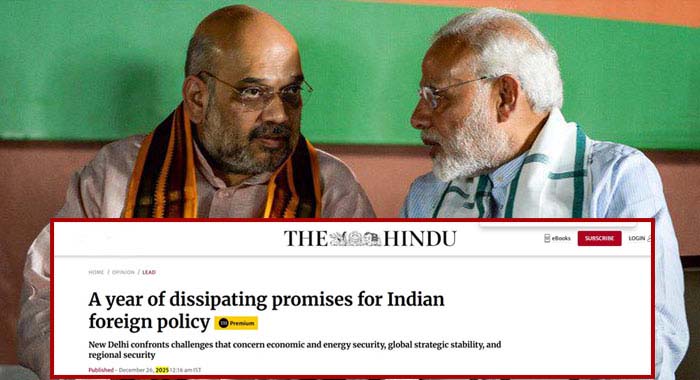
A leading Indian newspaper, The Hindu, has described 2025 as a year of significant diplomatic embarrassment for India, stating that expectations associated with Prime Minister Narendra Modi’s foreign policy failed to translate into tangible outcomes on the global stage.
In an in-depth analysis, The Hindu characterized the year as one marked by unfulfilled promises and declining diplomatic leverage, arguing that symbolic diplomacy, personal rapport with world leaders, and narrative-driven engagement could not substitute for real economic, military, and diplomatic power. The newspaper noted that India made commitments to both itself and its international partners without possessing the influence or capacity required to deliver on them.
The report highlighted that India’s relationship with the United States faced unprecedented strain in 2025, describing it as the most challenging year of bilateral ties this century. According to The Hindu, the imposition of a 25 percent US tariff, additional restrictions on Russian oil, and curbs on H-1B visas underscored the conditional and interest-driven nature of the India–US partnership. The paper further observed that, compared to 2017, India’s role in the 2025 US National Security Strategy had been significantly reduced.
Despite numerous high-level engagements with China and Russia, The Hindu reported that no meaningful progress was achieved on security issues along the Line of Actual Control, while investment barriers persisted. India’s influence remained largely symbolic, and under US pressure, New Delhi was compelled to soften its stance on Russian oil imports.
The newspaper also termed the Pahalgam false-flag incident a serious security failure, acknowledging that India’s subsequent military actions failed to secure broad international diplomatic support. It further noted that official silence over aircraft losses following Operation Sindoor damaged India’s credibility.
Additional diplomatic setbacks cited by The Hindu included the announcement of a Pakistan–Saudi Arabia mutual defense agreement, described as another blow to India’s regional standing. The paper observed that Indian analysts are increasingly recognizing Pakistan’s leadership as disciplined and strategically coherent.
According to the report, India–Bangladesh relations have deteriorated to their lowest point in years, prompting the newspaper to warn the Indian government that the narrative of “Vishwa Guru” risks devolving into that of a “Vishwa Victim.” The Hindu emphasized that India’s tendency to externalize blame remains a major obstacle to reform and realistic policy formulation.
Commenting on the analysis, experts stated that The Hindu has laid bare the weaknesses of India’s diplomacy, reinforcing the view that optics-driven foreign policy cannot deliver sustainable results. Analysts noted that the newspaper’s candid assessment validates Pakistan’s long-held position that India’s external posture relies heavily on perception management rather than substantive outcomes.
Experts further argued that the analysis reflects a broader strategic shift, indicating that India is no longer viewed as an indispensable partner by the United States, thereby weakening New Delhi’s deterrence narrative at the global level. Observers also pointed to The Hindu’s acknowledgment that certain countries supported Pakistan’s military actions, contradicting claims that Pakistan is diplomatically isolated.
Political and diplomatic analysts concluded by noting the irony that India’s expressions of concern over minority rights in neighboring countries ring hollow unless accompanied by credible action to protect minorities within India itself.



