
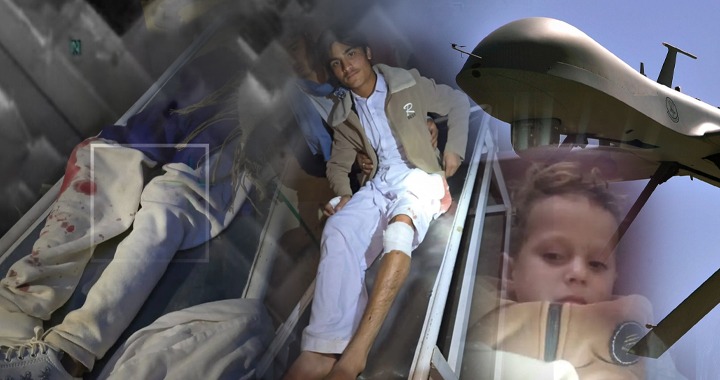
A drone attack struck Mosaki village in Mir Ali tehsil of North Waziristan, injuring three children and two men, local sources confirmed on Wednesday, adding to a growing list of incidents in which civilians have borne the brunt of aerial attacks in Pakistan’s former tribal belt.
According to initial reports, the drone strike caused serious injuries to the victims, who were immediately shifted to Khalifa Gul Nawaz Hospital for medical treatment. Hospital sources later confirmed that all injured individuals are out of danger.
Upon receiving information about the incident, Mir Ali Tehsil Coordinator Sadaf Dawar and Joint Secretary Masood-ur-Rehman, along with other workers, reached the hospital to oversee medical assistance and inquire about the condition of the injured.
Authorities have launched an investigation into the attack, while security officials continue to assess the circumstances surrounding the drone strike.
The Mir Ali incident is the latest in a disturbing pattern of attacks and explosions affecting civilian areas across Khyber Pakhtunkhwa, where children have increasingly emerged as victims of militant violence involving rockets, drones, and explosive remnants.
A day later, widely circulated footage exposed militants deliberately moving with small children to shield themselves from potential drone or ground action by security forces. Officials said such tactics were aimed at exploiting innocent lives and launching propaganda campaigns whenever casualties occurred.
Earlier in December, ten children were injured in Issuri village of Mir Ali when an old explosive device left behind by militants detonated after the children unknowingly began playing with it. Local residents said the area had previously been used as a militant hideout, leaving behind dangerous unexploded ordnance.
Another drone-related incident was reported in Janikhel area of Bannu, where five civilians, including children, were injured. Police records and security assessments have shown that commercially available quadcopters retrofitted with explosives are increasingly being used in residential areas, often causing indiscriminate harm.
Security forces have repeatedly warned that such devices lack accuracy and pose a serious threat to civilian life. In December, authorities issued a public safety advisory across parts of the tribal belt, urging residents to keep children away from open fields, roadsides, and unfamiliar objects due to the presence of explosive devices planted or abandoned by militants.
Further incidents reported later in the month included a drone attack in Kurram’s Gondalabad area, which injured four children, and another strike on a religious school in Tank district, where nine madrassa students were wounded during the night.
The trend continued into the final days of December, when terrorists opened fire near Sherkala Mor in Lakki Marwat, killing the young son of a police sub-inspector and injuring another child, in what officials described as a deliberate act of intimidation.
Security officials say these incidents collectively underscore the evolving threat posed by banned militant outfits, including the use of drones, explosive remnants, and direct attacks on civilian targets. Investigations into the Mir Ali drone attack are ongoing, as authorities continue efforts to curb the spread of aerial and ground-based militant tactics that have increasingly endangered children and non-combatants.



