
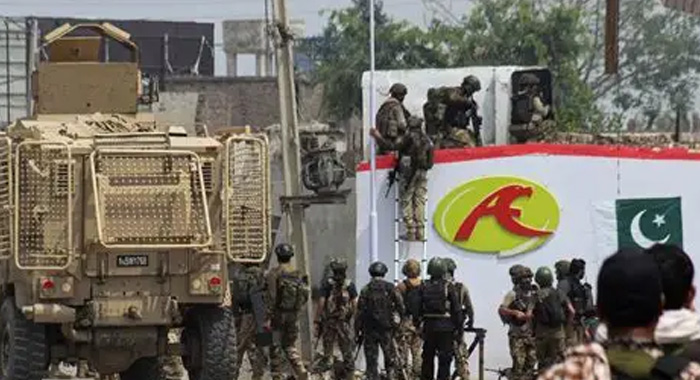
Terrorism is not a challenge confined to the armed forces or any single state institution; it is a collective war of the entire Pakistani nation. The struggle to transform Pakistan into a peaceful, stable, and prosperous state demands unified, coordinated, and sustained efforts from all segments of society political leadership, state institutions, and the public alike. Individual or fragmented approaches cannot yield positive or lasting results.
At a time when Pakistan faces complex internal and external security challenges, political polarization and blame-shifting risk further destabilizing the internal front. The recent remarks by the Director General ISPR rightly underscore that expecting success in the fight against terrorism by isolating responsibility to one institution is an emotionally driven and flawed assessment. Equally critical is the clear message that any individual, group, or political actor found facilitating or supporting terrorism directly or indirectly must be held accountable without exception.
There should be no room for ambiguity, compromise, or “ifs and buts” when it comes to terrorism. If Pakistan is to achieve political stability, economic recovery, and long-term development, it must confront terrorists and their facilitators with complete resolve. Without dismantling these networks, neither terrorism can be eradicated nor can the foundations of political and economic stability be strengthened.
A major external challenge remains Afghanistan. The emerging alignment between Afghanistan and India particularly when it manifests as Pakistan-hostile posturing raises serious security concerns. While Afghanistan’s relations with any country are its sovereign right, such relations become unacceptable when they are used to undermine Pakistan’s stability or enable anti-Pakistan proxy activities. Even more alarming is the continued support and patronage reportedly extended by Afghan authorities to the Tehreek-e-Taliban Pakistan (TTP) and other terrorist groups, which has directly exacerbated Pakistan’s security challenges, especially in Khyber Pakhtunkhwa.
On the diplomatic front, Pakistan has consistently raised its concerns regarding the use of Afghan soil for terrorist activities against Pakistan. However, despite multiple engagements and dialogue platforms in Doha, Qatar, and Saudi Arabia, meaningful and actionable responses from the Afghan side have remained absent. Without Afghanistan’s clear political will and practical measures, preventing cross-border terrorism is not possible.
Domestically, the visible divide between the federal government and the Khyber Pakhtunkhwa provincial government—particularly regarding Afghanistan and counterterrorism policy is deeply concerning. The DG ISPR’s observation that the political environment in Khyber Pakhtunkhwa may be inadvertently enabling terrorist exploitation warrants serious reflection. Given that the province has already borne the brunt of terrorism and remains on the frontline, any political stance that weakens collective resolve or creates confusion is untenable.
Political disagreements are natural, but they must not translate into confrontational rhetoric on national security. The solution lies in dialogue, coordination, and a shared political strategy. It is also important to recognize that political leaders across party lines in Khyber Pakhtunkhwa broadly share similar concerns regarding terrorism; therefore, deepening divisions serves no constructive purpose and only fuels public mistrust.
Claims that negotiations alone without a clear framework, credible stakeholders, defined timelines, and guaranteed facilitators can resolve the terrorism challenge must be accompanied by transparent and realistic strategies. Critical questions remain unanswered: Who will negotiate? With whom? Under what conditions? And with what guarantees? These questions demand clarity, particularly from those advocating dialogue as an alternative to decisive action.
At the same time, political parties currently in power must also introspect on their own role in leading and owning the political dimension of the war against terrorism. Counterterrorism cannot succeed without strong, united political leadership complementing the efforts of state institutions.
There is still time for Pakistan to step back from divisive politics and move toward a consensus-based national approach. Through dialogue, mutual understanding, and collective responsibility, Pakistan can strengthen its internal cohesion and confront terrorism with unity and determination. The national interest of Pakistan lies not in political point-scoring, but in standing together against a common existential threat.



