
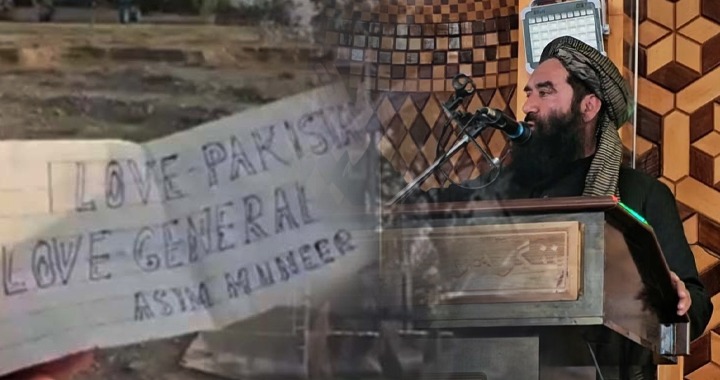
The recent remarks by Noorullah Noori, a senior figure within the Afghan Taliban, claiming widespread public support for the group’s stance against Pakistan, are increasingly being challenged by emerging ground realities that paint a far more complex and contradictory picture.
Noori’s assertion that “the people of eastern and western Afghanistan are our army” appears less a reflection of reality and more an attempt to project unity at a time when internal fractures and public dissatisfaction are becoming harder to conceal. Such statements, delivered during a visit to Nangarhar, come amid growing evidence that segments of Afghan society are not only disillusioned with Taliban rule but, in some cases, openly critical of it.
A recent video circulating on social media from Barmal district in Paktika province underscores this shift. In the video, an Afghan citizen expresses admiration for Pakistan and its military leadership, a sentiment that directly contradicts the Taliban’s claim of unanimous public alignment. The message is significant not merely for its content, but for what it represents, a willingness among ordinary Afghans to voice dissent despite the risks involved.
This emerging pattern is further reinforced by reports of rising armed resistance against Taliban authorities in multiple regions. Attacks targeting Taliban positions have been reported with increasing frequency, suggesting that opposition is not confined to rhetoric but is taking organized, and at times violent, forms. These developments point toward a widening gap between the Taliban’s official narrative and the lived experiences of many Afghans.
Adding another layer to this evolving landscape is the formation of political and social alliances opposed to Taliban rule. These alliances reportedly include a broad spectrum of Afghan society, political actors, civil society members, and individuals from diverse backgrounds, indicating that resistance to the Taliban is neither isolated nor insignificant. Instead, it reflects a growing convergence of voices seeking an alternative to the current governance structure.
Midway through this narrative lies a critical question: why does the Taliban leadership continue to emphasize “popular support” so insistently?
One possible explanation is that such claims serve as a tool of strategic messaging aimed at both domestic and international audiences. Internally, projecting an image of unanimous backing may be intended to deter dissent and prevent the coalescence of opposition into a large-scale movement. Externally, it may function as an attempt to legitimize their position, portraying themselves as a government rooted in public will rather than coercion.
However, reports suggesting that citizens have, at times, been compelled to participate in pro-Taliban gatherings cast further doubt on the authenticity of this so-called support. If public backing were as widespread and voluntary as claimed, the need for coercion would arguably be minimal.
The contradiction becomes even more pronounced when considering independent assessments indicating a divided public opinion within Afghanistan. While some segments may align with the Taliban’s stance, others have reportedly expressed support for actions targeting Taliban positions, reflecting a society far from unified.
Moreover, criticism from anti-Taliban political currents highlights another dimension, the accusation that the Taliban’s policies and associations have contributed to instability and compromised Afghanistan’s sovereignty. Such critiques not only challenge the group’s governance but also question its broader strategic direction.
Taken together, these elements suggest that the Taliban’s narrative of universal public support is increasingly difficult to sustain. Instead, what is emerging is a more fragmented reality, one marked by dissent, resistance, and competing visions for Afghanistan’s future.
In this context, Noori’s statements may be less an accurate assessment of public sentiment and more a reflection of a leadership grappling with the pressures of maintaining control in the face of mounting internal and external challenges.



