
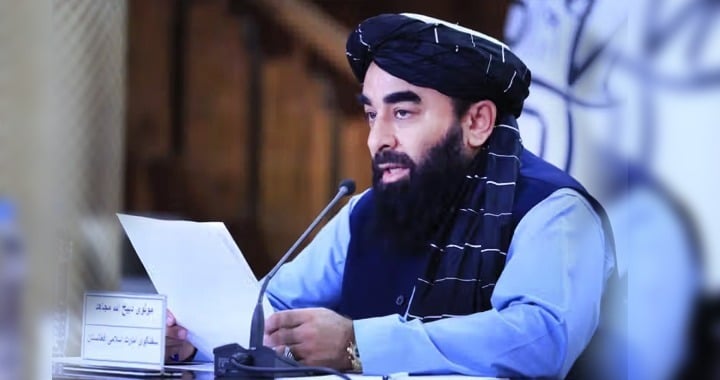
Taliban spokesman Zabihullah Mujahid has rejected any political settlement that would bring opposition groups back into Afghanistan’s power structure, arguing that their return would only recreate conditions the country has already experienced.
In an interview published on Thursday, 13 August, Mujahid portrayed Afghanistan’s opposition as fragmented groups pursuing different agendas and dismissed the record of previous political arrangements as unsuccessful. He argued that those who oppose the Taliban had already been tested and that giving them a share in power would risk taking Afghanistan back to what he described as familiar conditions of the past.
Mujahid said the Taliban did not prevent Afghans from returning to the country, but stressed that returning to Afghanistan and participating in politics were two different matters. According to him, political participation by opposition figures was currently not in Afghanistan’s interest.
His comments effectively rule out, at least for now, any meaningful power-sharing arrangement with rival political forces. The position also reflects the Taliban’s continued insistence that political authority should remain concentrated within its existing system rather than be redistributed among opposition groups.
Badakhshan Claims Clash With Events on the Ground
The more striking part of Mujahid’s remarks concerned Badakhshan, where he rejected reports of serious unrest and said the province was calm and presented no major challenge to the Taliban administration.
He characterized earlier reports concerning dissident commander Juma Khan Fateh as propaganda, claiming that Fateh had been one of the Taliban administration’s prominent commanders in Badakhshan and that reports about his opposition to the Taliban were false.
Mujahid also downplayed the brief seizure of Yaftal district by the Sepahiyan-e Mihan Front, describing it as a limited threat that was brought under control within hours. He claimed that those responsible for attempting to create disorder were arrested.
He further asserted that the Taliban administration faced no major threat anywhere in Afghanistan.
Those claims, however, have come under scrutiny from developments that unfolded after the interview was conducted. Fighting between forces loyal to Juma Khan Fateh and Taliban forces has been reported in Nusay district of Badakhshan for the past two days, while opposition fronts have also carried out a series of attacks in the province in recent weeks.
The timing is particularly significant. Mujahid’s interview was recorded before the latest fighting, meaning his categorical portrayal of Badakhshan as calm was overtaken by events shortly afterwards.
He also attributed unrest in the province to outside intelligence agencies, without identifying any country specifically. Mujahid said there were no genuine protests in Badakhshan and accused foreign actors of encouraging young Afghans to create instability.
The repeated references to foreign involvement fit a broader Taliban narrative in which armed opposition and unrest are frequently presented as externally driven rather than as expressions of domestic political or security grievances.
Yet the succession of incidents in Badakhshan, including attacks on Taliban officials and armed confrontations with opposition groups, suggests that the province remains a significant security pressure point.
Mujahid’s Message to Pakistan
Mujahid also addressed tensions with Pakistan, blaming what he described as a small military group in Islamabad for taking Pakistan’s interests hostage and seeking to keep Afghanistan locked in confrontation.
At the same time, he claimed that the Taliban administration did not want conflict with Pakistan and would not allow Afghan territory to be used against other countries.
His remarks nevertheless contained a familiar warning. Mujahid said that whenever Pakistan engaged in talks, the Taliban responded through dialogue, when accusations were made, they answered them, and when fighting or alleged violations of Afghan territory occurred, the Taliban responded militarily.
The statement reflects the Taliban’s attempt to present itself as unwilling to initiate conflict while maintaining its claim to respond forcefully when it considers its territory or interests threatened.
Taken together, Mujahid’s remarks reveal a Taliban administration seeking to project political confidence and internal control while simultaneously confronting questions about growing opposition activity, particularly in Badakhshan.
The contrast is difficult to overlook. The Taliban insists that Afghanistan faces no major security threat, dismisses opposition activity as propaganda and rejects political accommodation with its rivals. Yet renewed fighting in Badakhshan and a series of attacks targeting Taliban personnel indicate that the security landscape remains considerably more complicated than the official narrative suggests.



