
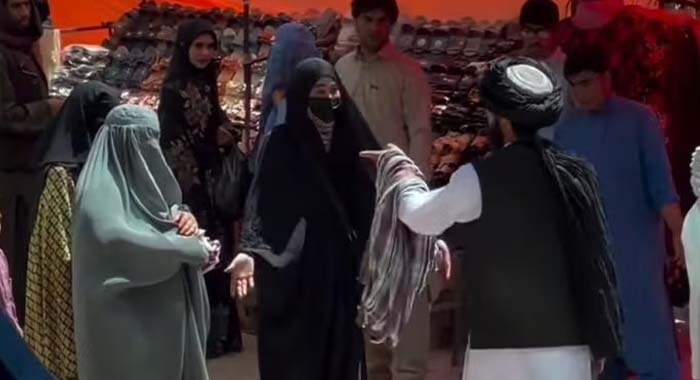
Women in Herat say Taliban enforcement units responsible for regulating public morality have intensified street level monitoring, reviving a pattern of harassment, intimidation, and physical abuse across the city. Residents report that patrols have expanded in recent days, with women being stopped while walking, riding public transport, or moving through commercial areas.
According to multiple local accounts, girls as young as twelve and elderly women approaching seventy have been questioned, verbally abused, and in some cases physically mistreated for wearing clothing that does not align with Taliban preferences. The scrutiny is not limited to perceived immodesty but extends to specific styles of dress that the authorities now deem unacceptable in public.
At the center of the crackdown is the manto, a long outer garment commonly worn by women in Herat. For decades, it has functioned as a culturally accepted alternative to the burqa, particularly in urban areas. Though modest and widely used across parts of the Muslim world, the garment has recently been barred by local Taliban authorities, effectively banning women from appearing in public while wearing it.
Residents say enforcement teams have been stationed at major intersections and crowded zones throughout the city. These include central markets, transport hubs, and main roads where foot traffic is heavy. Officers reportedly stop women to inspect their clothing, interrogate them about their appearance, and in some cases order them to return home immediately.
Escalating Confrontations in Public Areas
Eyewitnesses describe a sharp escalation in enforcement methods. Taliban officers have been seen halting buses, taxis, and rickshaws, ordering women to disembark if they are not wearing a burqa or prayer veil. Drivers who transport such women are reportedly threatened or assaulted.
In one incident, a morality officer was seen striking a driver for allowing a woman dressed in a manto to ride in his vehicle. In other cases, drivers were warned that they would face punishment for carrying women dressed in banned clothing.
Several women were detained following disputes with patrols in busy areas, including one major square where enforcement actions continued over multiple days. Those taken into custody were reportedly moved to undisclosed locations, with no information provided to families about their whereabouts or release.
Voices From the Street
Women who experienced these encounters say that compliance offered little protection. Many stressed that their clothing fully covered their bodies, yet they were still targeted for not conforming to specific Taliban interpretations.
One woman described being forced off a public bus despite wearing heavy winter clothing. She said no taxi or rickshaw was allowed to take her, leaving her stranded in a central square for an extended period. When she was finally permitted to leave, she was forced to walk through side streets to avoid further confrontation.
Another woman recounted traveling with her brother when their vehicle was stopped. Officers reportedly beat the driver in front of them for carrying women dressed in manto, issuing warnings to transport workers rather than detaining the passengers.
Men accompanying female relatives have also been drawn into confrontations. One father said his twelve-year-old daughter was stopped by officers who told her she should not leave home without a burqa. When he objected and explained her age, he was detained briefly. During that time, he witnessed numerous other women being stopped and questioned.
In another case, two sisters attempting to reach a cardiac hospital were blocked at multiple access points because one of them was wearing a manto. According to their account, enforcement personnel were positioned at alley entrances, effectively sealing off entire streets to prevent women dressed in the banned garment from passing.
Residents also described tense verbal clashes. One witness recalled an elderly woman confronting officers loudly in public, questioning why bystanders remained silent while women were being humiliated in the street.
A Pattern of Expanding Restrictions
This latest enforcement wave follows earlier incidents in which women, including healthcare workers, were detained or beaten in Herat for dress related violations. Despite the risks, some women have continued wearing the manto or Arab style hijab, seeing it as a culturally normal and religiously modest form of clothing.
Local authorities have also imposed restrictions on access to public services. Women without a burqa have been turned away from government offices and medical facilities in parts of the city and surrounding districts. In several instances, women were reportedly prevented from entering hospitals because their clothing did not meet enforcement standards.
Together, these measures signal a tightening of social control in Herat, where clothing has become a primary tool for regulating women’s mobility, visibility, and participation in public life. For many residents, the renewed presence of morality patrols has transformed everyday movement into a calculated risk, shaped by fear of detention, public humiliation, or violence.



