
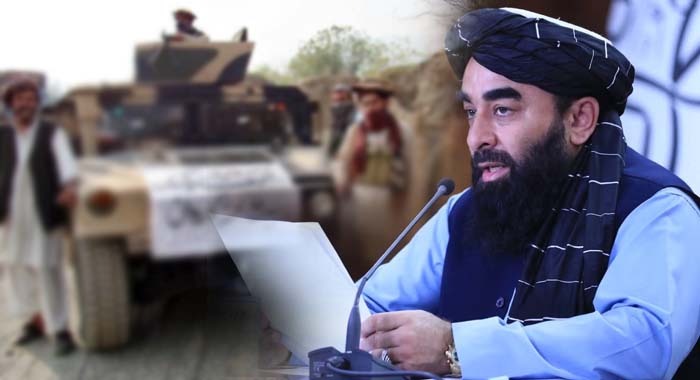
The Taliban’s chief spokesperson, Zabihullah Mujahid, has warned Pakistan against what he described as attempts to exert influence or control over the Taliban administration, asserting that the group makes decisions independently and does not operate under Islamabad’s direction.
Mujahid rejected claims that the Taliban remains dependent on Pakistan, dismissing such assertions as the product of “two decades of propaganda.” He said certain circles within Pakistan had expected the Taliban, after returning to power, to govern Afghanistan in line with Pakistani interests—an expectation he described as unrealistic. He urged Pakistan to abandon what he termed “wishful thinking” about controlling the Taliban leadership.
Despite Mujahid’s remarks, it is widely documented in internal and international assessments that many senior Taliban leaders and commanders lived in Pakistani cities such as Quetta and Peshawar during the years of conflict with the former Afghan government and foreign forces. During that period, Pakistan—under pressure from Kabul and Washington—largely refrained from forcibly removing Taliban figures, including members of the Haqqani network.
For years, analysts have argued that Pakistan viewed the Taliban as a strategic tool to counter the previous Afghan government and to limit India’s influence in Afghanistan. However, relations have deteriorated sharply since the Taliban returned to power.
A major point of contention has been the Taliban’s refusal to act against Tehreek-e-Taliban Pakistan (TTP) militants operating from Afghan territory. Pakistan has repeatedly sought cooperation to curb cross-border attacks, particularly after one of the deadliest years for its security forces, marked by thousands of incidents and heavy casualties. Those requests were rejected by the Taliban leadership.
As tensions escalated, Pakistan carried out military strikes inside Afghan territory and initiated the deportation of large numbers of Afghan migrants. Taliban officials have stated that these measures have not changed their stance.
Mujahid accused Pakistan of contributing to instability in Afghanistan at the behest of the United States. He alleged that a coordinated strategy was underway involving elements within Pakistan, linked to broader geopolitical agendas, including renewed discussions around strategic military installations.
According to Mujahid, another core dispute stems from what he called Pakistan’s attempt to maintain overarching influence over the Taliban government. He insisted that the Taliban is neither a proxy nor subordinate to any foreign power and has established its own governance framework, independently managing Afghanistan’s domestic and foreign affairs.
He claimed that this autonomy angered a “special circle” within Pakistan, leading to what he described as efforts to undermine the Taliban administration. While asserting that the Taliban is capable of defending itself, Mujahid declined to provide details about its military strength, citing security considerations.
Once again, he rejected allegations that the Taliban is providing sanctuary to TTP fighters, arguing that the group does not rely on Afghan territory. He claimed that TTP elements operate from within Pakistan itself and described them as displaced individuals who have already been “contained.”
Questions Raised
Mujahid’s statement, while forceful, raises serious and unavoidable questions—particularly in light of regional and global security concerns repeatedly voiced at international forums.
If the Taliban leadership is fully independent, how does it explain the persistent presence of anti-Pakistan militant groups operating from Afghan soil, a concern raised not only by Pakistan but also by regional powers and global institutions?
If the Taliban does not shelter or facilitate the TTP, why has it consistently refused to take verifiable action against a group responsible for unprecedented violence inside Pakistan, despite repeated diplomatic engagements?
How does the Taliban reconcile its claims of neutrality with growing strategic engagement with India, a country openly hostile to Pakistan, especially amid reports of cooperation that allegedly include intelligence coordination, training, and advanced surveillance capabilities?
If Afghanistan poses no threat to regional stability, why do concerns continue to surface from multiple directions—regional actors, global security bodies, and international monitoring mechanisms—regarding terrorism, cross-border militancy, and misuse of Afghan territory?
Most importantly, on what grounds can the Taliban reject Pakistan’s right to defend its territorial integrity and civilian population, when credible evidence has repeatedly pointed to cross-border attacks involving Afghan nationals and armed groups operating with apparent freedom inside Afghanistan?
And finally, given Pakistan’s long record of political engagement, economic support, and diplomatic facilitation for Afghanistan, is the Taliban now disowning the very history that enabled its survival and return to power?
These are questions that go beyond rhetoric—and ones the international community is increasingly demanding clear, verifiable answers to.



