
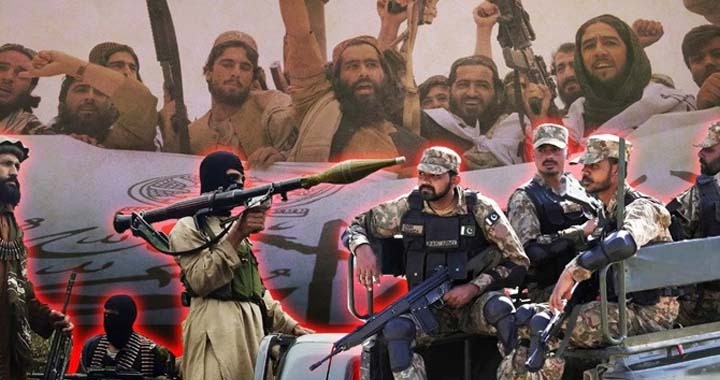
Last year, Taliban supreme leader Sheikh Hibatullah Akhunzada issued a decree declaring armed operations outside Afghanistan, particularly against Pakistan, as illegal and un-Islamic. The ruling was projected as both a religious injunction and a policy signal, aimed at assuring neighbors that Afghan territory would not be used for external militancy.
On paper, the decree carried theological weight and executive authority. In practice, its enforcement appears ghostlike, visible in text, absent on ground.
The February 9 broadcast on Tolo News lays bare this contradiction.
When televised panels openly glorify attacks on Pakistan, label terrorism as “Jihad,” and endorse groups such as BLA, the issue transcends media irresponsibility. It raises structural questions about command, control, and ideological coherence within the Taliban governance apparatus.
If Akhunzada’s word is supreme, why does public incitement flourish unchecked?
Authority vs Autonomy Inside the Emirate
There are three possible readings of this disconnect.
First, fragmented authority.
Power inside the Taliban regime is neither monolithic nor uniformly disciplined. Field commanders, intelligence factions, ideological hardliners, and Haqqani-aligned networks often operate with varying degrees of autonomy. Media narratives may reflect these internal dispersions rather than centralized policy.
Second, strategic ambiguity.
Kabul may benefit from maintaining plausible deniability, issuing formal decrees for diplomatic consumption while allowing anti-Pakistan rhetoric and militant signaling to persist as leverage.
Third, enforcement incapacity.
Even if the decree is sincere, the regime may lack institutional mechanisms to regulate media, militant actors, and ideological influencers operating within its territory.
Each scenario erodes the credibility of the edict.
From Religious Injunction to Propaganda Theater
Labeling terror attacks as “Jihad” is not merely rhetorical excess, it is doctrinal weaponization.
Such framing attempts to:
Provide religious legitimacy to violence
Recruit ideological sympathizers
Blur lines between insurgency and faith duty
Export radical narratives beyond borders
When aired on national television, the messaging acquires state-adjacent legitimacy, whether intended or not.
Silence from authorities then becomes interpretive endorsement.
Evidence Beyond the Screen
The credibility gap surrounding the decree is not confined to rhetoric alone. Developments on the ground increasingly mirror the same contradiction between proclamation and practice.
Recent intelligence assessments point to the coordination meetings inside Afghanistan between senior figures of Tehreek-e-Taliban Pakistan (TTP) and the Baloch Liberation Army (BLA), including reported engagements in Kandahar aimed at synchronizing attacks within Pakistan.
Parallel to this, video footage has surfaced showing Taliban-appointed officials publicly praising TTP leader Noor Wali Mehsud, signaling ideological accommodation rather than suppression.
At the multilateral level, United Nations sanctions monitoring reports continue to document operational latitude enjoyed by militant entities inside Afghanistan, including TTP and allied networks.
Individually, each development raises concern. Collectively, they construct a pattern, one that sits uneasily beside Akhunzada’s prohibition on external militancy.
International Concerns, Revalidated Again
Forums such as the UN Security Council and BRICS counterterror dialogues have repeatedly warned about terrorist safe havens, facilitation pipelines, and ideological ecosystems operating from Afghan soil.
Recent UN monitoring findings detailing the presence, mobility, and logistical integration of multiple militant organizations have only deepened those concerns.
The threat matrix is not limited to physical sanctuaries but extends into:
Information warfare
Narrative radicalization
Psychological operations
Cross-border ideological mobilization
In modern conflict architecture, media incitement is an operational layer, not background noise.
The Question Kabul Must Answer
The central question is no longer whether anti-Pakistan actors operate from Afghan territory.
The question is governance accountability.
If Sheikh Hibatullah Akhunzada’s decree stands, then enforcement failure reflects an authority deficit.
If enforcement is absent by design, then the decree becomes diplomatic theater.
Either way, the credibility cost is borne by the acting Taliban administration.
Because when television studios echo war chants, when analysts sanctify violence, and when terrorist attacks are wrapped in religious vocabulary, the gap between proclamation and policy becomes impossible to conceal.
And the world notices.



