
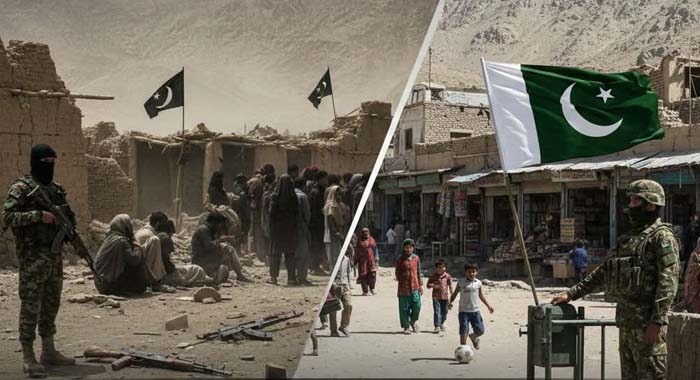
Many argue that Pakistan has already conducted 22 major military operations, yet terrorists remain, so new operations are pointless.
This claim is either ignorance of ground realities or a deliberate denial of facts.
If these 22 operations had achieved nothing, one must ask: what was the actual situation in Swat, Khyber, and Waziristan before 2008, and what is it today?
In Swat, Sufi Muhammad and later Maulana Fazlullah had established a parallel government. They had their own courts, laws, and a terrorist system where the state of Pakistan had no presence. People were flogged, killed, and ruled through fear.
After these 22 operations, however, Swat transformed into a region where people from across the country travel freely for tourism. Today, families, children, elderly citizens, and tourists move about without fear, a tangible proof that the rule of terrorists has ended.
In Khyber district, Mangal Bagh had created a state within a state. He ran his own courts where decisions were enforced over the Afridi and Shinwari tribes. Witnesses to this system are still alive today.
After the 22 operations, Mangal Bagh was eliminated, state writ restored, and a time came when thousands of visitors from Peshawar and other parts of Pakistan could safely visit Khyber. While conditions have partially worsened in recent years, two, three, or four years ago, tourism and public movement had become normal, signaling a major transformation in the region.
In Waziristan, terrorist commanders like Hakimullah Mehsud had their own governments and courts. Locals were forced to migrate from their own areas out of fear.
The 22 operations dismantled the organized terrorist structure, and Waziristan eventually became a place where people from across the country could visit safely. Areas once abandoned by locals for survival later welcomed visitors, a change proven not by statements, but by ground realities.
From 2008 to 2010, over 90 percent of FATA had lost state control. Each agency was dominated by a militia, a commander, and a parallel non-state government. The most significant and undeniable outcome of these 22 operations was the elimination of these parallel governments, courts, and terrorist systems, restoring Pakistan’s authority.
It is true that terrorist incidents still occur today, but terrorists no longer hold permanent control, nor do they run governments or courts. They cannot operate openly in markets as they once did. Today’s attacks are mostly enabled by internal facilitation and safe havens in Afghanistan, but these groups operate covertly, aware that permanent territorial control is no longer possible.
This is the real success of the 22 military operations, felt daily by the people of Swat, Khyber, and Waziristan. Denying this reality is not ignorance—it is a deliberate evasion of the facts.



