
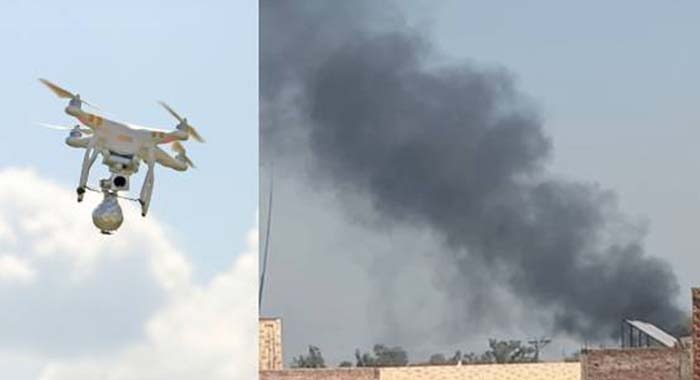
The recent fire exchange in Lakki Marwat, one of the worst terror-stricken districts in southern KP, is not an isolated firefight. It is part of a widening insurgent recalibration unfolding across southern Khyber Pakhtunkhwa, where militant groups are blending conventional guerrilla tactics with low-cost aerial capability, testing both state response and community resilience.
For years, Lakki Marwat and neighboring Bannu have functioned as kinetic corridors rather than static battlegrounds. Militants do not aim to hold territory in the classical sense. Instead, they seek to create episodic insecurity, striking through ambushes, targeted assassinations, improvised explosive devices, and increasingly, commercial drones.
The firefight between police, peace committee volunteers, and militants in Takhti Khel reflects this hybrid conflict environment. Local lashkars no longer operate merely as intelligence eyes. They are now frontline buffers, absorbing first contact in many rural belts before formal security reinforcements arrive.
From Ground Assaults to Airborne Harassment
Drone usage marks the most visible tactical shift.
Initially used for surveillance, quadcopters now serve three operational purposes:
Reconnaissance of police movement
Monitoring of lashkar mobilization
Limited payload delivery, including grenade drops
This evolution mirrors militant learning curves observed in other conflict theaters, where commercially available drones were repurposed into battlefield multipliers.
Southern KP’s terrain amplifies their effectiveness. Sparse settlements, agricultural belts, and low-rise infrastructure allow drones to operate with minimal radar or visual disruption.
The psychological effect often outweighs physical damage. A drone hovering overhead disperses gatherings, stalls patrols, and forces security units into defensive posture.
Lashkars as Force Multipliers
Despite technological escalation, militants continue encountering hardened tribal resistance.
Peace committees, especially in Lakki Marwat’s rural clusters, have revived a model rooted in communal self-defense. Armed volunteers coordinate with police, share ground intelligence, and in some cases engage militants directly, as seen in Takhti Khel.
This fusion of state and society complicates militant planning.
Where militants once exploited governance vacuums, they now face layered resistance:
Police checkpoints
Military quick-response units
Community lashkars
Drone watchers and informant grids
Takhti Khel tribes, in particular, have built a reputation for rapid mobilization, often confronting infiltrators before they establish operational footholds.
The Drone Warning Ecosystem
One of the most striking developments is the emergence of civilian early-warning messaging.
Recent peace committee advisories circulated publicly, warning residents about militant drone flights and urging them to track or neutralize low-flying devices.
This signals two trends:
Militant drone presence has become frequent enough to require public alerts.
Communities are adapting countermeasures, both physical and observational.
In insurgency environments, when civilians begin recognizing aerial signatures, the technological advantage of militants narrows.
Why Lakki Marwat and Bannu Remain Hot Zones
Several structural factors keep these districts under militant focus:
Geographic adjacency to former FATA infiltration routes
Forested and semi-mountainous hideouts
Historic militant facilitation networks
Limited urban surveillance density
Additionally, both districts sit along logistical transition belts linking tribal terrains with settled districts, making them operational springboards rather than end targets.
Drone deployment enhances this corridor strategy, allowing militants to reconnoiter deeper targets without physical penetration.
Security Doctrine Response
Security forces are recalibrating accordingly.
Countermeasures now include:
Signal jamming trials in sensitive zones
Drone detection radars in select compounds
Training police in anti-drone firing drills
Night patrol expansion using thermal optics
However, technological response requires scale and funding, whereas militant drone acquisition remains cheap, deniable, and replaceable.
This asymmetry keeps the threat persistent.
The Psychological Battlespace
Militancy in southern KP is no longer purely territorial. It is psychological conditioning.
Drone flights, sporadic attacks, and night firing create an atmosphere of constant anticipation. The goal is erosion of normalcy, not necessarily battlefield victory.
Yet Takhti Khel’s latest resistance episode undercuts that objective.
Every militant retreat under community pressure sends a countersignal, that aerial intimidation alone cannot fracture localized defense cohesion.
The Road Ahead
If current patterns persist, three trajectories are likely:
Increased militant drone experimentation
Expanded lashkar-security coordination
Greater federal investment in rural counter-drone systems
Southern KP is no longer facing yesterday’s insurgency. It is confronting an adaptive militant architecture where sky and soil are now contested simultaneously.
Takhti Khel’s firefight, therefore, is not merely a clash. It is a snapshot of a conflict mid-mutation, where technology, terrain, and tribal willpower intersect in shaping the next phase of Pakistan’s counterterror landscape.



