
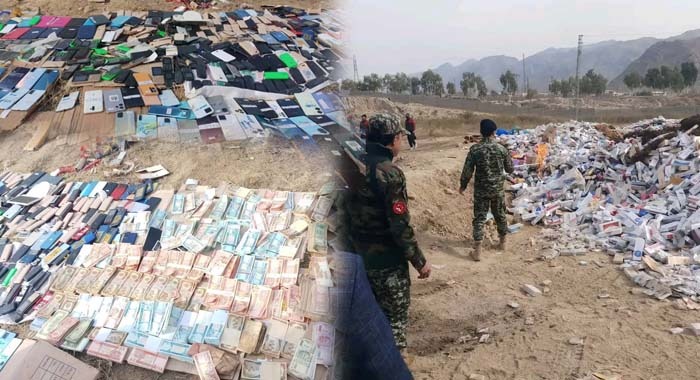
Security forces at the Pakistan Afghanistan border crossing in Torkham have seized and destroyed a massive consignment of illegal and foreign smuggled goods, reinforcing concerns that smuggling activity and counterfeit currency remain central components of terror financing inside Pakistan.
Officials said the contraband weighed approximately forty three tons and carried an estimated value of three hundred fifty eight million rupees. The haul included counterfeit currency, medicines, mobile phones, soft drinks, cigarettes and various other items. Senior security officials and customs officers supervised the burn exercise after completing the legal process for destruction.
Authorities said the seizure was part of ongoing operations targeting entrenched smuggling networks that operate on both sides of Torkham. These networks rely on established cross border routes that feed a shadow economy stretching from the trade corridors of Khyber district to the remote pockets of Tirah Valley. Officials said smuggling of goods, narcotics and even human trafficking remains one of the most persistent obstacles to counterterrorism efforts in the region since the proceeds sustain militant groups and criminal syndicates.
Smuggling, Counterfeit Currency and Terror Financing
Security agencies said they have repeatedly traced financial flows from counterfeit currency printing, narcotics and illegal imports to various militant outfits active in the border belt. The latest seizure at Torkham, they added, is part of a broader effort to choke off these lifelines by striking at their financial base across Khyber Pakhtunkhwa.
Fears Over Afghan Soil and Cross Border Threats Reinforced
Taliban authorities recently claimed to have foiled a major arms smuggling attempt aimed at entering Pakistan’s Kurram district. A significant cache of weapons was seized and three suspects were arrested before the consignment could cross into Pakistani territory. Investigations are underway in Afghanistan to determine the wider network behind the attempt. The incident has reinforced longstanding international concerns that Afghan soil continues to enable cross border threats despite repeated regional calls for dismantling foreign and domestic militant networks.
The latest burn exercise at Torkham, officials added, is part of a broader campaign targeting the financial backbone of groups active in Khyber Pakhtunkhwa and the adjoining tribal belt.
Narcotics Cultivation and Terror Nexus in Tirah Valley
Earlier disclosures revealed a large scale narcotics smuggling network operating from Afghanistan into Khyber Pakhtunkhwa, with around twelve thousand acres under drug cultivation in Tirah and adjoining areas. Profits estimated between 1.8 and 2.5 million dollars were found to be directly funneled to Khawarij groups. Sources described a political terror crime nexus that continues to obstruct counter narcotics and counterterrorism efforts.
Narco Terrorism Exposed After Attacks in Wana and Islamabad
Recent attacks in Wana and Islamabad highlighted the lethal convergence of narcotics trafficking, extremist financing and cross border complicity. Security forces have repeatedly targeted drug fields and trafficking routes in Tirah Valley, though officials warn that the shadow economy of narcotics continues to fuel future attacks and undermine stability.
Central Asian Leaders Warn of Afghan Based Threats
Central Asian states meeting in Tashkent stressed persistent threats from Taliban controlled Afghanistan, citing ongoing narcotics flows, arms trafficking, illegal migration and extremist activity. While the region seeks cautious engagement for connectivity projects, leaders underscored that security risks from Afghan based networks remain acute.
DG ISPR on Illegal Smuggling and Terror Funding
Pakistan’s military spokesperson recently delivered one of the most detailed official briefings on how illegal smuggling has evolved into a primary funding artery for militant outfits across the country.
The DG ISPR said that any country supplying military equipment to the Afghan Taliban regime is effectively placing weapons in the hands of terrorists. He warned that Pakistan has traced a rise in a toxic anti state narrative to X accounts operated from abroad. These accounts appear local but are controlled by foreign handlers who work around the clock to amplify disinformation and distort political debates.
He said the solution to terrorism lies in the National Action Plan, and its structured implementation has been achieved in Balochistan where district, divisional and provincial committees now monitor counterterrorism and security coordination. However, the same level of structured implementation is missing in Khyber Pakhtunkhwa, which continues to face a high intensity threat.
Iranian Diesel Smuggling and Direct Militant Funding
The DG ISPR revealed that before the recent crackdown by the army, the Frontier Corps and provincial authorities, more than twenty point five million litres of Iranian diesel were being smuggled into Pakistan daily. After the crackdown, the volume has dropped to approximately two point seven million litres per day. He said the proceeds from this smuggling directly fund militant groups such as the BLA and BYC.
He explained that the illegal diesel economy had become one of the biggest engines of terror financing in the region. Smuggling syndicates provided militants with resources, protection and mobility while evading law enforcement through bribery, political influence and local networks.
Strengthened Policing and Community Engagement in Balochistan
He said the National Action Plan framework has brought policing to twenty seven districts in Balochistan, covering almost eighty six percent of the province. Security forces and the provincial government maintain nearly one hundred forty community engagements daily, totalling around four thousand interactions per month. Officials believe these engagements are steadily weakening militant sanctuaries and reducing the space for hostile non state actors.
The spokesperson said long term gains depend on sustained pressure against smuggling networks, financial facilitators and political elements that provide these networks with protection. He said terrorism cannot be controlled unless illegal economies are dismantled and national narratives are defended against foreign influence.
Federal Minister Links KP Governance Failures to Drug Cartels and Terrorism
The information minister accused the KP government of allowing drug cartels, illegal mining networks and non customs paid vehicles to thrive despite an escalating terror threat. He said political protection of smuggling networks and drug traffickers has enabled criminal groups and militants to operate without fear, warning that unchecked illegal economies weaken national cohesion and embolden extremist networks.



