
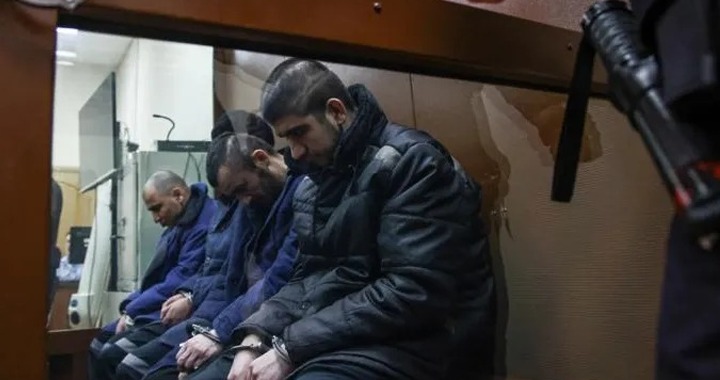
A Russian court has been informed that the perpetrators of the deadly Crocus City Hall terrorist attack received specialized militant training outside Russia, including in Türkiye and Afghanistan highlighting growing concerns over Afghanistan’s continued role as a breeding ground for extremist networks.
According to Russia’s state news agency TASS, sources at the Second Western District Military Court confirmed that the attackers underwent professional training and displayed advanced weapons-handling capabilities. Judicial officials stated that all defendants demonstrated skills consistent with structured terrorist instruction rather than lone-actor radicalization.
Court testimony revealed that one of the accused, Shamsidin Fariduni, exhibited a notably high level of marksmanship during questioning, reinforcing the assessment that the group had received formal combat training. Authorities further indicated that two operational cells were initially prepared for the assault before being merged into a single coordinated unit, a claim denied by the defendants.
The court was told that Fariduni had originally been scheduled to travel from Türkiye through mountainous routes into Afghanistan to join Islamic State Khorasan Province (ISKP), an extremist group known to operate from Afghan territory. However, due to winter closures along those routes, he was allegedly redirected to participate directly in the Moscow attack.
Investigators stated that Fariduni played a key operational role, including recruiting accomplices inside Russia, conducting reconnaissance of the Crocus City Hall venue, arranging transportation, and procuring weapons. Judicial authorities rejected his claim that the group did not intend to kill children, noting that evidence contradicts this assertion.
The court also heard that the attack’s organizers promised the perpetrators a payment of one million roubles. Following the assault, the attackers allegedly attempted to flee toward Ukraine, where the payment was to be delivered.
The March 22, 2024 attack occurred in the Moscow suburbs when four armed assailants opened fire on concertgoers shortly before an event began and later set the venue on fire. At least 149 people were killed and more than 600 injured, marking one of the deadliest terrorist attacks in modern Russian history.
The Islamic State claimed responsibility for the massacre. Legal proceedings against the suspects began in the summer of 2024, with all four principal defendants apprehended shortly after the attack.
Russian authorities have repeatedly warned that Afghanistan continues to serve as a hub for extremist training, recruitment, and cross-border terrorist planning, posing a persistent threat to regional and global security. Officials stressed that the findings underscore the international dimensions of modern terrorism and the urgent need for stronger counterterrorism cooperation.



