
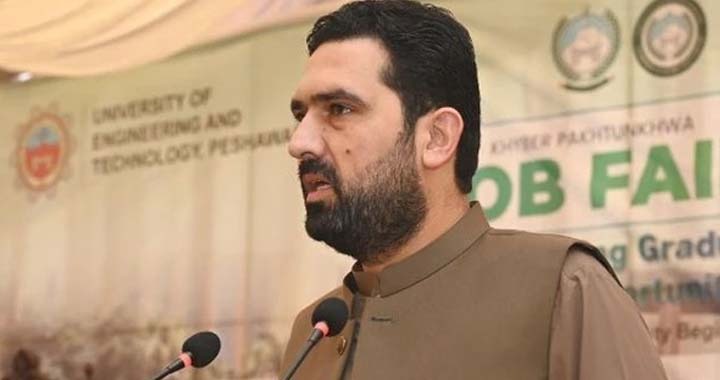
The Chief Minister of Khyber Pakhtunkhwa or better if called as PTI’s CM KP, Muhammad Sohail Afridi, while addressing a two-day Health Awareness Conference organized by the Pakistan Medical Association in Peshawar, chose to deliver a speech that was political to its core. Speaking at a forum meant for medical professionals and public health discourse, the Chief Minister asserted that under systems of oppression and fascism only roads are built, not nations, and that nations are formed only when rich and poor are subject to the same law and system of justice.
He further claimed that Khyber Pakhtunkhwa is the only province where one hundred percent of the population is being provided free healthcare, that the free healthcare programme initiated by his jailed leader in Punjab has been discontinued, and that in the upcoming fiscal year the nutrition sector will receive a substantial increase in resources. Health and education, he said, are directly linked to public welfare and are therefore being prioritized.
The Chief Minister also spoke of governance and service delivery reforms, collective responsibility, and argued that evading responsibility is itself a form of corruption. He reiterated that the provincial government is making governance transparent and effective. He repeated that the struggle to dismantle parallel systems for the rich and the poor has begun, that the struggle initiated alongside Imran Khan continues with full force, and that Pakistan will be turned into a strong state in line with the dreams of Allama Iqbal and Quaid-e-Azam.
He also praised Dr Yasmin Rashid for what he described as her courage and resilience, stating that she has fought her part of the battle and is now fighting on behalf of others.
When rhetoric collides with record
First and foremost, the Chief Minister should have completely refrained from political rhetoric at a medical event. Even more troubling is the ease with which verifiable distortions were presented as facts. This is not accidental, it is symptomatic of a political culture rooted in opportunism, where venue, occasion, and audience are irrelevant so long as propaganda, however misleading, is amplified.
The claim of one hundred percent free healthcare demands an answer. Is this facility being provided from Pakistan Tehreek-e-Insaf funds, or from the national exchequer? Is public money being spent purely on political considerations, without accountability, sustainability analysis, or concern for long term consequences, simply to manufacture a narrative of benevolence?
This leads to questions that the Chief Minister, the KP government, and PTI must answer.
After nearly thirteen years in power across three tenures in Khyber Pakhtunkhwa, has PTI contributed to national cohesion on internal and external security challenges, particularly the war against terrorism, or has it deepened divisions and fragmented national resolve?
Nation building aside, is it not a fact that the very foundation of PTI’s politics is built on hatred and polarization? Even a cursory review of the party’s political conduct over the past thirteen to fourteen years shows that its leadership has consistently refused to sit with, cooperate with, or even symbolically engage other political forces on critical national issues. Why? Because consensus would have deflated the entire political balloon on which the party’s leadership thrives. The founder of PTI has repeatedly demonstrated that neither the state nor national interest has priority over personal power, a record supported by numerous statements that stand as evidence. This is not merely unfortunate; it is astonishing how shamelessly PTI leaders continue to defend this posture.
As for the claim of equal law and justice for rich and poor, the founder of PTI’s nearly four-year tenure at the federal level failed spectacularly on this front. Examples abound where his so-called visionary leadership acted in complete contradiction to these principles. Even if that record is set aside, the constitutional and legal violations committed in the final days of his government are now a documented part of Pakistan’s political history.
The most startling assertion, however, was the claim that the struggle to end parallel systems for rich and poor has now begun, once again. This raises a basic question. What exactly has this party and its leadership, particularly its so-called leader, been doing for the past three decades?
The claim of building Pakistan in accordance with the dreams of Allama Iqbal and Quaid-e-Azam collapses further when examined against PTI’s stance on terrorism. At a time when the state and the nation have moved towards a unified and uncompromising narrative against terrorism, PTI and its government in Khyber Pakhtunkhwa have maintained an entirely separate narrative and policy. This divergence is not rooted in national interest but in narrow group and personal calculations.
History records that it was the founder of PTI who facilitated the return and resettlement of militants, associated with the banned Tehreek-e-Taliban Pakistan (TTP) in the province, a decision he publicly owned with pride. While today the state’s position is clear that no negotiations will be held with those who reject Pakistan’s constitution, flag, and anthem, PTI until very recently maintained the exact opposite stance, persistently advocating talks with terrorists. Only after legal and political pressure tightened did one of its spokesmen suddenly rediscover the state’s position.
Regarding Dr Yasmin Rashid, she is undoubtedly a composed and capable politician. Yet she stands on the wrong side of history. Whether sooner or later, when that realization arrives, it is reasonable to believe that she too, like others before her, will publicly distance herself from this party and its narrative, and apologize to the nation.
The final message for Chief Minister Suhail Afridi is simple. Instead of repeating falsehoods, he should expose the true face of the so-called visionary leader, the founder of PTI. Those closest to him already know that this former sportsman is a deeply self-absorbed individual, politically small, consumed entirely by his own persona. If Sohail Afridi chooses truth over loyalty, history may remember him as someone who served the nation. If not, humiliation and irrelevance will be his only legacy.



