
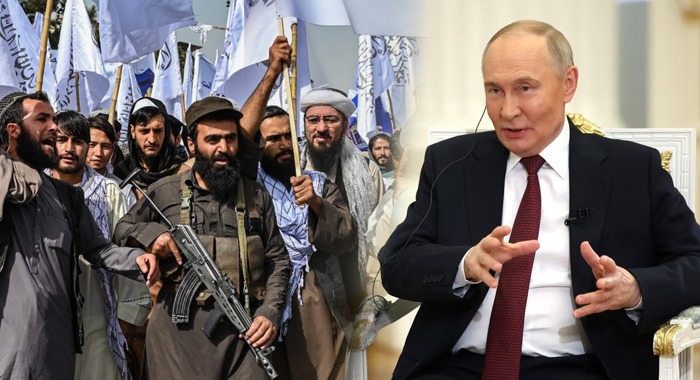
Russian President Vladimir Putin has offered a surprisingly confident assessment of Taliban rule, saying Afghanistan under the group faces “certain problems” but remains firmly under Taliban control. He called the decades of conflict in the country “a horrible situation” yet emphasised that the Taliban government is running affairs.
Putin did not explain what those “problems” are, although Russian intelligence and diplomats have repeatedly warned that Afghanistan is becoming a hub for transnational militant networks. Still, the Russian leader insisted that the Taliban had taken action against groups like ISIS, a remark that appears to play down concerns earlier raised by Moscow itself.
Putin arrived in India on Thursday to a warm welcome from Prime Minister Narendra Modi, even as Washington urged New Delhi to reduce engagement with Russia.
A Shift in Moscow’s Narrative
Here lies the central question. If Afghanistan is truly “in control” and functioning as Putin says, does this validate what regional states have long argued, that the Afghan Taliban is not only tolerating and enabling extremist networks but directly handling and exporting violence across borders. If control exists, then so does responsibility. The Taliban can no longer hide behind the excuse of internal chaos.
And if Russia is suddenly describing a controlled and functional Taliban state, is this a strategic U turn. Is the Kremlin now contradicting its own diplomats, or is Moscow also divided on the Taliban question, just as the Taliban leadership itself is split between the Haqqani network and the Kandahar faction. Or is the Russian President deliberately sidelining those warnings to pursue a separate geopolitical track with Kabul.
The questions sharpen further because only days before Putin’s remarks, senior Russian officials had sounded the alarm. Deputy Foreign Minister Dmitry Lyubinsky stated that terrorism in Afghanistan and the Middle East remained a serious and evolving threat. He said the threat from international terrorist organisations had intensified.
Meanwhile, regional fears continue to rise after five Chinese citizens were killed near the Tajikistan Afghanistan border. Tajikistan has publicly said the attacks were planned from Afghan territory. Chinese workers in Tajikistan were targeted by drones, and the Taliban claim they are cooperating with Dushanbe to identify the attackers. These are precisely the kinds of cross border operations that point to a permissive or complicit host state environment.
If the Taliban are indeed in full control, the case against them becomes far more urgent, and global demands for collective action far more credible.
Recognition and Its Consequences
Putin has now become the first leader of a major UN Security Council member state to recognise the Taliban administration. He defended the group’s performance on counterterrorism and drug trafficking, two areas where Western governments say the Taliban have failed and where evidence points to systematic state involvement.
Western nations continue to tie recognition to human rights improvements, especially women’s rights and education. Those concerns resurfaced during the interview itself when the two Indian women journalists questioned Putin about the Taliban’s restrictions. They referred specifically to Taliban Foreign Minister Amir Khan Muttaqi’s recent visit to India, during which women journalists were barred from his press conference, a decision that triggered widespread criticism in Indian media and political circles.
Putin maintained that engagement with the Taliban was necessary in order to influence developments in Afghanistan. Using the press conference controversy as an example, he said Muttaqi’s presence in Delhi had allowed women journalists to voice their objections directly.
But if Russia now accepts that Afghanistan is a coherent, functioning state under Taliban command, the implication is unavoidable. Responsibility for attacks on neighbours, for the sheltering of transnational militants, and for the export of extremist violence sits squarely with Kabul. And that raises the most pressing question for the global community, if Afghanistan is in control, then time is running out for the world to respond.



