
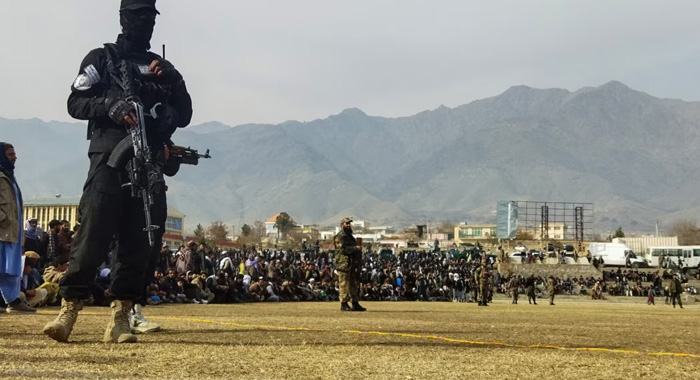
Afghanistan’s ruling Taliban authorities have publicly flogged five individuals, including two women, in Balkh and Parwan provinces, reinforcing concerns over the country’s deteriorating human rights environment and the regime’s continued reliance on corporal punishment as a tool of public control.
In a statement issued on Wednesday, February 18, the Taliban’s Supreme Court confirmed that the individuals were convicted of offences including facilitating prostitution, selling alcohol, and engaging in extramarital relations. Each person received 39 lashes and was sentenced to prison terms ranging from one to two years.
The punishments were carried out in public gatherings attended by civilian and military officials, religious scholars, local representatives, court visitors, and members of the public. According to official accounts, one woman and two men were flogged in Balkh province, while one woman and one man were punished in Parwan province.
Over the past two weeks alone, at least 53 individuals including women have been publicly flogged across Afghanistan, reflecting an intensification of corporal punishments under Taliban rule. The growing frequency of such public lashings signals an increasingly rigid and punitive judicial approach that has drawn widespread international condemnation.
Human rights advocates argue that the Taliban’s justice system lacks transparency, due process protections, and independent legal oversight. Trials are often conducted behind closed doors, with limited access to legal representation or appeal mechanisms. The public enforcement of corporal punishment, particularly against women, underscores what critics describe as a broader pattern of repression and systemic gender discrimination.
Since returning to power, the Taliban have faced sustained criticism for rolling back civil liberties, restricting women’s rights, limiting access to education and employment, and enforcing severe social controls. The continued use of public flogging reinforces Afghanistan’s growing international isolation and deepens concerns about the country’s trajectory under the current regime.
International organizations have consistently opposed corporal punishment, classifying it as cruel, inhuman, and degrading treatment under global human rights standards. Despite this, Taliban officials defend such measures as the implementation of their interpretation of Islamic law, rejecting external criticism.
Observers warn that the normalization of public punishments contributes to a climate of fear, further shrinking civic space and undermining prospects for legal reform or social progress. As Afghanistan grapples with economic hardship, humanitarian crises, and diplomatic marginalization, the persistence of harsh punitive measures highlights the widening gap between the regime’s governance model and internationally recognized human rights norms.



