
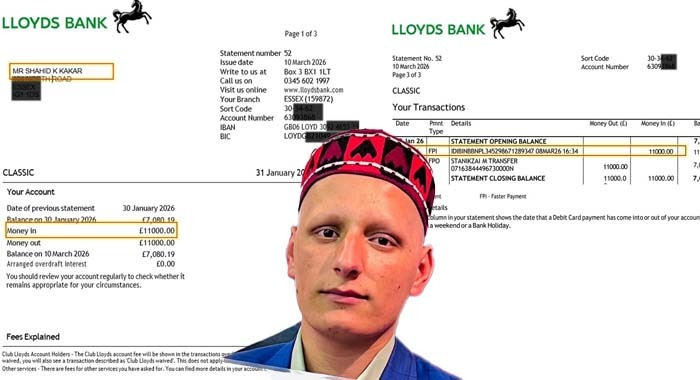
Recent financial evidence suggests that the protest organized by the Pashtun Tahafuz Movement (PTM) in London may have been funded by external actors, raising serious questions about the motivations and orchestration behind the demonstrations.
According to verified records obtained from the UK chapter of PTM, Shahid Kakar, Deputy Chief Executive of PTM UK, received a sum of £11,000 on 8 March 2026 from an Indian bank account in connection with the call for the London protest. Financial documents and account statements have been reviewed to trace the origin and purpose of the transaction.
Security analysts and sources monitoring diaspora networks indicate that such transactions strongly suggest that the protest was not an organic grassroots initiative, but part of a pre-planned campaign supported by foreign interests seeking to influence international perceptions of Pakistan.
Further investigations reveal coordination with Afghan diaspora networks, signaling that the demonstrations were not solely driven by local grievances but orchestrated with external facilitation to amplify anti-Pakistan narratives in Western capitals.
The timing, scale, and origin of the funds transferred to Shahid Kakar highlight the involvement of handlers and facilitators operating across borders, raising critical concerns regarding the role of foreign intelligence agencies and organizations in sustaining and directing PTM’s international activities.
Officials point out that the funding of PTM’s international protests serves as a soft proxy platform to project anti-Pakistan rhetoric abroad, bypassing Pakistan’s judicial and political systems where local grievances could otherwise be addressed through legitimate channels.
Authorities have urged scrutiny and verification of such financial transactions, emphasizing the need for transparency and accountability in the organization of international political movements, particularly when they have potential implications for national security and international relations.
The emerging evidence underscores the importance of monitoring foreign interference in domestic and diaspora political activities, while highlighting concerns that certain movements may be leveraged to damage Pakistan’s global image rather than represent authentic civil advocacy.



