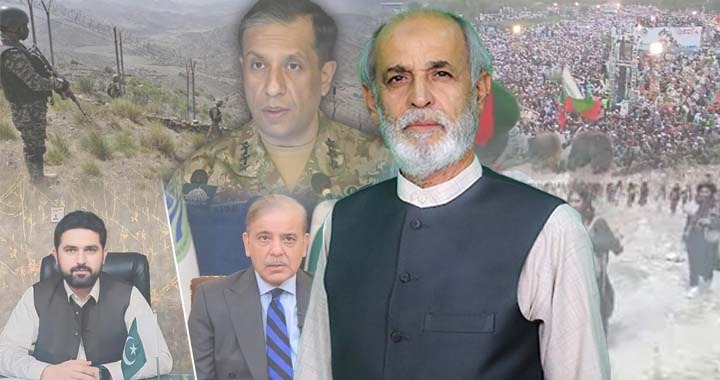
The mass gathering held on 7 December in Peshawar by the Khyber Pakhtunkhwa government was less a platform for governance and more a stage for political theatrics. While KP Chief Minister Sohail Afridi and allied leaders dominated the speeches, the absence of any concrete roadmap on law and order, security, or counter-terrorism was glaring. The event highlighted a troubling reality: political rhetoric continues to overshadow the urgent needs of the province and its citizens.
When Speeches Replace Strategy
What should have been a forum to discuss Peshawar’s deteriorating security situation became a vehicle for criticism of the federal government. Speakers condemned the DG ISPR’s recent briefing, levelled accusations regarding restrictions on former Prime Minister Imran Khan, and even threatened federal institutions. Yet, amid these grand statements, the suffering of ordinary citizens went unnoticed. Terrorist attacks continue on an almost routine basis, but not a single leader acknowledged the fear and losses experienced by the residents. Street crime, snatching, robberies, and lawlessness have surged, but the gathering remained silent on these realities. Infrastructure shortcomings—from chronic electricity and gas outages to neglected urban services—were similarly ignored.
Political Mobilisation Over Public Service
Since 2013, the Pakistan Tehreek-e-Insan (PTI) has governed Khyber Pakhtunkhwa. Historical patterns show a consistent prioritisation of political agitation over governance. The 2014 protests, led by Imran Khan with the support of Pervaiz Khattak, set a precedent: sustained political mobilisation, even at the cost of public order, became the party’s modus operandi. Today, the same pattern persists, with mass gatherings serving primarily as platforms to demand Imran Khan’s release and project political dominance, rather than to address the pressing issues of law and order or economic hardship.
This political strategy has, in effect, widened the gap between the people and the state. Citizens see their leaders engaged in rhetoric while day-to-day governance collapses. Criticism of the DG ISPR, for instance, while legitimate in a healthy democracy, appears here less as accountability and more as retaliation—a reflection of the growing politicisation of institutions meant to safeguard the nation.
The Cost of Neglect
The consequences of such neglect are tangible. Tribal areas and the broader province face worsening security conditions, where terrorism, extremism, and cross-border threats remain unchecked. Economic hardships—rising unemployment, inflation, and poverty—compound public frustration. The ordinary citizen, already living under a cloud of fear and uncertainty, is sidelined in political agendas. Arrests, curfews, and fines targeting innocents exacerbate the perception of state indifference, further eroding trust between the public and authorities.
Even foreign policy concerns intertwine with domestic governance. Pakistan’s approach to Afghan relations, including the Doha-mediated efforts to reduce cross-border tensions and secure the Afghan border, is directly affected by internal political instability. The failure to maintain coherent law and order domestically undermines the country’s position in these negotiations.
Rhetoric vs Reality
If political rallies alone determined governance, Pakistan would have been transformed long ago, given the sheer frequency of such gatherings by parties like Jamat-e-Islami. But rhetoric cannot substitute for action. While political mobilisation remains a key component of democratic expression, it cannot come at the expense of security, public welfare, and the credibility of state institutions.
The Peshawar jalsa is symptomatic of a broader malaise. Political parties continue to prioritise partisan narratives, leaving ordinary citizens grappling with violence, crime, and economic precarity. Until the PTI-led government of Khyber Pakhtunkhwa; and indeed all political actors, shifts focus from spectacle to substance, the province will remain caught in a cycle of rhetoric, unrest, and governance gaps.
Pakistan’s stability, both internal and at its borders, depends on an alignment between political will and practical governance. Public gatherings, speeches, and protests are important in a democracy, but they must be accompanied by actionable plans to safeguard security, uphold the rule of law, and address citizens’ grievances. Otherwise, the gap between the state and its people will continue to widen, and the consequences, ranging from domestic instability to diminished credibility in regional diplomacy, will be borne by ordinary Pakistanis.