
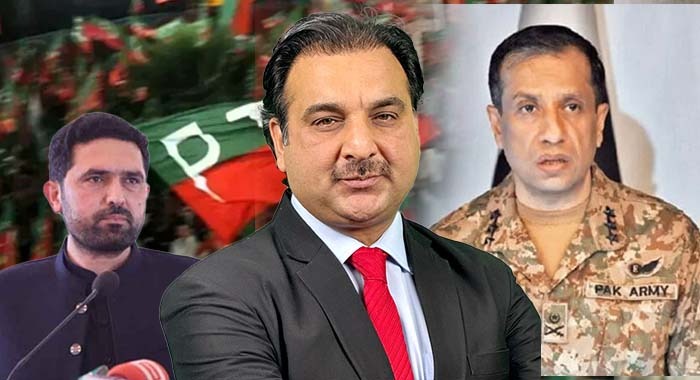
(Irfan Khan)
The press conference held by Director General of Inter-Services Public Relations (DG ISPR) Lieutenant General Ahmed Sharif Chaudhry represents a watershed moment in Pakistan’s contemporary civil-military landscape. What was most striking about the proceedings was not merely the content of the statements but the tenor and intensity of the language employed. For the first time in recent memory, the DG ISPR articulated a level of direct anger and pointed critique that broke long-standing traditions of cautious or measured responses from the military’s official spokesperson.
Historically, the DG ISPR has maintained a measured approach in addressing public controversies, particularly those involving political entities or civil society actors. Criticism has typically been couched in neutral or formal language, avoiding personal targeting or the use of language that could escalate tensions. However, this press briefing deviated from that precedent. The DG ISPR’s language was unmistakably sharp, especially regarding the Pakistan Tehreek-e-Insaf (PTI) and its leadership, reflecting a deeper frustration at narratives being propagated against the army and the state by certain political actors.
According to the transcript of the press conference, the genesis of this reaction was linked to a series of provocative incidents, including social media activity on platforms associated with PTI leadership, particularly Imran Khan, and tweets referencing high-ranking military officials. The DG ISPR emphasized that the military had, for years, tolerated political criticism, including anti-establishment narratives from various parties, but the PTI’s recent actions were unprecedented in their nature and frequency.
The DG highlighted that for the past four years, PTI had been constructing a narrative against the army and the state. While political parties in Pakistan are expected to criticize governments, the military, or bureaucratic institutions as part of their democratic function, the DG suggested that PTI’s actions went beyond legitimate political discourse. According to his account, certain individuals within and affiliated with PTI were allegedly collaborating with foreign platforms to broadcast content undermining the state. The transcript lists a series of figures, including Shehbaz Gill, Shehzad Akbar, Moeed Peerzada, and Adil Raja, who are accused of amplifying these narratives, making vlogs, and disseminating content that could be used by Pakistan’s adversaries abroad.
What emerges from this narrative is a portrayal of PTI not merely as a political party engaging in opposition politics but as a collective actor intentionally challenging state institutions, according to the DG ISPR. The implications of such a perception are significant. By publicly expressing this level of anger and critique, the DG ISPR has signaled that the military’s patience has limits, and certain activities deemed inimical to national security are no longer tolerable.
A key part of the DG ISPR’s statement focused on the failure of PTI leadership to address fundamental governance issues during its tenure. He highlighted that, despite having been in government from 2018 to 2021 in Khyber Pakhtunkhwa, PTI failed to secure the province’s due share under the National Finance Commission (NFC) award and neglected development priorities such as education, healthcare, and infrastructure. The press conference framed these omissions not as minor bureaucratic lapses but as part of a larger narrative whereby PTI allegedly misled the public into believing it had acted on their behalf. The DG’s assessment emphasized that, while PTI engages in highly visible protests and street politics, tangible governance and development outcomes were lacking during its rule.
The DG ISPR also drew attention to the pattern of recurring street protests and demonstrations. He noted that in the last 20 months, PTI had organized 17 or 18 protests, using these events as a mechanism for political gain rather than policy advocacy. These observations were contextualized with reference to earlier political leaders within PTI, such as Parvez Khattak and Mehmood Khan, suggesting that while faces change, the political tactics of the party remain consistent: mobilization of mass protests, anti-establishment rhetoric, and leveraging social media for targeted narratives.
Another dimension addressed in the press conference was the intersection of politics and public perception. The DG ISPR argued that PTI has cultivated a particular worldview among its followers, one in which dissenting opinions are automatically dismissed as biased or corrupt, while only those who endorse PTI’s narrative are considered acceptable. This, according to the DG, creates a self-reinforcing cycle of misinformation and polarization, where political discourse is reduced to the constant accusation of corruption against others, allowing PTI to avoid scrutiny of its own governance record.
Moreover, the DG ISPR’s statements extended beyond domestic political critique to touch upon Pakistan’s security posture and regional counter-terrorism challenges. He highlighted recent intelligence-based operations along the Chaman border and across Balochistan, emphasizing that these actions are part of a broader strategy to enhance peace and security in Pakistan. The operations, according to the DG, are necessary due to repeated failures of diplomatic efforts, including negotiations in Istanbul, Beijing, and Saudi Arabia, aimed at curbing cross-border terrorist activity and destabilizing actors in Afghanistan. The military’s patience, he warned, is not limitless, and any attempts to exploit Pakistan’s internal vulnerabilities would be met with decisive action.
The press conference also addressed the issue of Afghan immigrants residing illegally in Pakistan. The DG clarified that the government is taking steps consistent with international norms to regulate the status of foreign nationals, emphasizing that other countries, including Iran, have also taken similar measures. The discussion of this topic was framed within the broader narrative of national security and the need to maintain social order, reinforcing the interconnectedness of domestic politics, law enforcement, and security imperatives.
From a political perspective, this press conference represents a significant escalation in the military’s public communication. For decades, Pakistan’s civil-military relations have been characterized by subtle diplomacy, indirect messaging, and a cautious balance between critique and restraint. This briefing, however, was unusually direct in its condemnation of a single political party and its leadership, marking a rhetorical shift that analysts will likely interpret as a warning signal. It is notable that the DG ISPR did not shy away from naming political figures, citing specific incidents, and providing a historical context for the military’s frustration. Such specificity is unusual in Pakistani military communications, which often rely on broader, more generalized statements.
The press conference also implicitly underscores the military’s self-perception as a guardian of national interest, capable of identifying narratives or actions that it perceives as threatening Pakistan’s stability. By framing the PTI’s political and social media activities as part of a broader campaign against the state, the DG ISPR is signaling a proactive stance, one that merges information operations, political monitoring, and conventional security measures. This multidimensional approach reflects an understanding of modern challenges, where public opinion, media narratives, and street-level activism intersect with traditional security concerns.
Critically, the DG ISPR’s remarks may also serve as a caution to other political actors, suggesting that the military is prepared to respond to anti-state activities, irrespective of their origin. The emphasis on accountability, historical governance records, and the failures of political leadership in ensuring development suggests a dual strategy: critique of the opposition’s methods, coupled with reinforcement of the military’s role as an arbiter of national stability. This dual strategy has significant implications for Pakistan’s political environment, potentially influencing the strategies of opposition parties and their engagement with the public.
The discussion of counter-terrorism operations and border security was particularly revealing, as it indicated a more assertive posture by Pakistan in dealing with cross-border threats. The DG ISPR noted that intelligence-based operations are ongoing and that the state is prepared to escalate measures if external actors continue to exploit instability in Afghanistan or attempt to conduct operations within Pakistan’s territory. The reference to negotiations in multiple international venues that failed, combined with a warning of potential consequences for the Islamic Emirate, underscores Pakistan’s broader strategic concerns and the military’s commitment to national security.
Furthermore, the DG’s comments on Afghan immigrants reflect a broader concern about demographic and security pressures within Pakistan. By linking immigration to national security, the press conference situates domestic policy within the larger framework of regional stability, highlighting the interconnectedness of internal governance, security policy, and demographic management. The military’s communication, therefore, is not merely about political critique but also about asserting a vision for national stability that encompasses multiple dimensions: security, governance, and social order.
From a media and public opinion standpoint, the press conference is likely to have significant repercussions. The directness of the DG ISPR’s language, combined with detailed historical references and critiques of PTI’s governance record, will provide analysts, journalists, and political commentators with a framework for interpreting military perspectives on contemporary political challenges. It is also likely to influence public perceptions, particularly among those following debates on governance, political accountability, and national security.
In conclusion, DG ISPR Lieutenant General Ahmed Sharif Chaudhry’s press conference represents a notable departure from the traditional cautious tone of military communications in Pakistan. The intensity and specificity of the statements signal a new level of engagement with political narratives, particularly those associated with PTI, while also reaffirming the military’s commitment to national security, governance oversight, and counter-terrorism operations. By linking domestic political critique with broader security concerns, the press conference offers a comprehensive view of how the military perceives its role in contemporary Pakistan and the limits of tolerance for narratives or actions it deems inimical to national stability.
Whether this represents a strategic recalibration or an isolated expression of frustration, the press conference is likely to shape Pakistan’s political discourse in the coming months. It underscores the persistent complexity of civil-military relations in the country and highlights the challenges faced by political actors operating within a landscape where public opinion, governance, and security are deeply intertwined. For policymakers, analysts, and citizens alike, the implications of this press briefing will be far-reaching, affecting everything from political strategy to media framing, and from governance accountability to national security priorities.
In sum, this press conference was more than a routine briefing; it was a statement of intent, a critique of political conduct, and a reaffirmation of the military’s vigilance over national interest. For the PTI, and for Pakistan’s political ecosystem more broadly, it marks a turning point, demanding both reflection and recalibration in the conduct of political narratives and street-level activism.



