
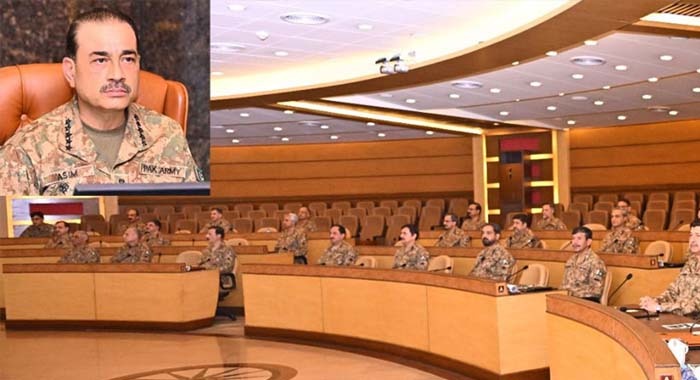
The Pakistan Army’s Corps Commanders’ Conference has delivered a firm and unambiguous message: no conspiracy against Pakistan’s national unity, security, stability, or sovereignty will be tolerated under any circumstances. The conference, chaired by Chief of Army Staff and Chief of Defence Forces Field Marshal Syed Asim Munir, underscored the unbreakable bond between the armed forces and the people of Pakistan, declaring that any attempt to create divisions between them will be decisively countered.
Addressing the forum, the Army Chief emphasized that Pakistan’s steady progress toward dignity, stability, and national resilience is rooted in the unwavering support of its people. The conference participants reiterated that Indian-sponsored terrorists, their facilitators, and their supporters will be dealt with decisively and without any leniency.
Pakistan’s security challenges, the forum noted, are neither new nor minor. For decades, the country has confronted terrorism, extremism, sectarian violence, and external interference. In this prolonged struggle, the sacrifices made by the Pakistan Army and law enforcement agencies have been immense and unforgettable. The conference observed that the nation’s fight against terrorism has evolved into a comprehensive national struggle, encompassing not only military efforts but also social, political, and ideological resolve.
Participants offered prayers for those martyred in recent terrorist incidents, including members of the armed forces as well as civilians men, women, children, and the elderly whose lives have been claimed by violence. This act of remembrance reaffirmed the state’s resolve that the blood of martyrs will never go in vain.
The Corps Commanders’ Conference made it unequivocally clear that any internal or external plot aimed at undermining Pakistan’s national security, sovereignty, stability, or dignity will be thwarted. The forum stressed that this was not a routine military meeting, but a clear articulation of the state’s strategic direction, priorities, and national narrative.
The conference highlighted that national unity and the strong relationship between the people and the armed forces remain central to Pakistan’s strength. History, the forum noted, has consistently shown that when the nation and its defenders stand united, no hostile force can weaken Pakistan.
The issue of Indian-sponsored terrorism was addressed as a matter grounded in facts rather than rhetoric. The forum reiterated that Pakistan has repeatedly presented evidence of India’s involvement in destabilizing activities across the region, including acts of sabotage in Balochistan, attacks in Khyber Pakhtunkhwa, and coordinated disinformation campaigns aimed at sowing mistrust between the armed forces and the public.
A comprehensive review of the internal and external security environment was conducted, reflecting the Pakistan Army’s constant vigilance amid rapidly evolving regional and global dynamics. The forum emphasized the growing importance of intelligence-based counterterrorism operations and commended the professionalism, courage, and sacrifices of security forces engaged in these efforts, terming such operations essential for national security.
A key aspect of the discussion was the outright rejection of any nexus between terrorism, criminal networks, and political interests. The forum conveyed a clear and firm message that no individual or group—regardless of political affiliation or ideological alignment will be allowed to undermine national unity, security, or stability. This stance was described as fundamental to upholding the rule of law and reinforcing the writ of the state.
The situation in Balochistan received special attention. While acknowledging the province’s historical challenges, including underdevelopment and external interference, the conference welcomed recent progress driven by coordinated efforts between the government and security institutions. The forum appreciated the Balochistan government’s special development initiatives, signaling a shift toward a holistic approach that combines security measures with sustainable development and inclusive governance.
The Corps Commanders’ Conference also reaffirmed Pakistan’s principled stance on international issues, reiterating unwavering support for the right to self-determination of the people of Kashmir and Palestine. The forum condemned ongoing human rights violations in Indian-occupied Kashmir and called for an immediate ceasefire in Gaza, uninterrupted humanitarian assistance, and the establishment of an independent Palestinian state in accordance with international law.
Concluding the conference, the Army Chief directed commanders to maintain the highest standards of operational readiness, discipline, training, and professionalism, while embracing modern innovations and emerging technologies. The forum acknowledged that contemporary warfare extends beyond conventional battlefields to include cyber warfare, information operations, and psychological dimensions, necessitating continuous adaptation and advanced training.
Overall, the Corps Commanders’ Conference conveyed a strong, clear, and resolute national message. It served as a warning not only to hostile external forces but also to internal elements seeking to undermine national cohesion. The conference reassured the people of Pakistan that their armed forces remain fully committed to safeguarding the country’s present and securing a peaceful, stable, and dignified future.
At a time when Pakistan faces economic pressures, political challenges, and regional tensions, the conference underscored the critical importance of national unity. It reaffirmed that through collective effort, resilience, and responsible conduct, Pakistan is steadily moving toward long-term stability. The message was one of confidence, resolve, and hope: united, vigilant, and determined, the nation and its armed forces stand prepared to confront every challenge ahead.



