
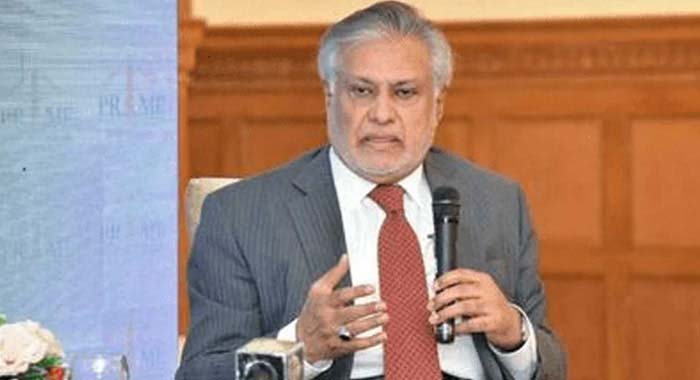
Deputy Prime Minister and Foreign Minister Ishaq Dar stated that Pakistan’s armed forces decisively countered Indian aggression in 2025, asserting that New Delhi’s arrogance was firmly checked and that lasting peace in South Asia remains impossible without a just resolution of the Kashmir dispute.
Addressing an annual news briefing, Ishaq Dar said Pakistan emerged from the recent confrontation with enhanced national prestige. He noted that despite being attacked, Pakistan demonstrated restraint and maturity, while its armed forces effectively defended the country. He revealed that Pakistani air defenses shot down seven Indian aircraft, emphasizing that Pakistan acted purely in self-defense despite possessing the capability to respond more forcefully. He added that Pakistan had every legal right to retaliate following Indian strikes.
The deputy prime minister strongly condemned India’s unilateral demographic and geographic changes in illegally occupied Jammu and Kashmir, describing them as a grave violation of international law and human rights. He reiterated that the Kashmir issue can only be resolved through the right to self-determination of the Kashmiri people, in line with UN resolutions. He also confirmed that Pakistan remains actively engaged with international forums on the Indus Waters Treaty, noting that Islamabad closed its airspace to India as a countermeasure.
Referring to recent hostilities, Ishaq Dar rejected what he termed baseless Indian allegations linked to the Pahalgam incident, stating that India has a consistent pattern of blaming Pakistan without evidence. He said India committed a “serious strategic mistake” by targeting Nur Khan Air Base, which prompted a calibrated Pakistani response. He clarified that Pakistan never sought external mediation for a ceasefire and that the decision to respond was jointly taken by the country’s civilian and military leadership on the night of May 9.
Highlighting operational details, he said Pakistan’s defense capabilities were tested during the brief four-day conflict. Over a 36-hour period, India launched approximately 80 drones, of which 79 were intercepted and neutralized. One drone caused minor damage to a military installation and injured a single individual, underscoring the effectiveness of Pakistan’s air defense systems.
On regional diplomacy, Ishaq Dar noted that Pakistan–Bangladesh relations saw a breakthrough in 2025, ending a prolonged period of stagnation. He reaffirmed that peace in South Asia will remain elusive until the Kashmir dispute is resolved permanently and justly.
Turning to economic diplomacy, the deputy prime minister said Pakistan continues to receive strong support from friendly countries. He expressed optimism that a USD 1 billion transaction with the United Arab Emirates would be finalized soon, easing a major financial obligation. He acknowledged sustained assistance from Saudi Arabia, a USD 4 billion state-to-state deposit from China, and USD 3 billion in support from the UAE during Pakistan’s challenging economic period.
He further explained that discussions are underway to convert previously rolled-over UAE payments into long-term investment, which would reduce debt pressure and provide greater economic stability. Prime Minister Shehbaz Sharif has also engaged UAE leadership on a potential USD 2 billion rollover, with both sides exploring investment-focused alternatives.
On Pakistan’s international standing, Ishaq Dar said the country’s global image has improved markedly, crediting proactive, result-oriented diplomacy. He praised the media for effectively highlighting Pakistan’s diplomatic and strategic achievements throughout the year.
Recalling the events following August 5, 2019, he said Pakistan remained vigilant against attempts to falsely implicate it after security incidents, noting how India exploited such narratives to justify unilateral actions in Kashmir. He emphasized that the Kashmir issue has a well-documented history under UN resolutions and that India itself has acknowledged its disputed status in the past.
Concluding his remarks, the deputy prime minister said recent developments reflect India’s mala fide intentions, warning that Pakistan will continue to raise these issues, including matters related to the Indus Waters Treaty, at appropriate international platforms.



