
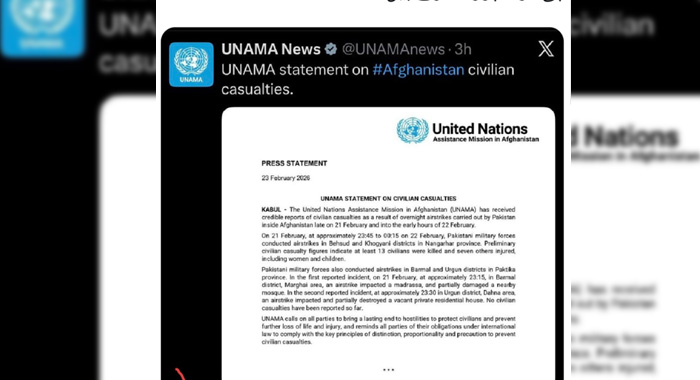
Pakistan has issued a strong and unequivocal rejoinder to the 23 February 2026 press release by the United Nations Assistance Mission in Afghanistan (UNAMA), expressing deep concern over what it described as a one-sided narrative that overlooks the core drivers of instability in the region.
In its official response, Pakistan stressed that the foremost responsibility for preventing civilian harm within Afghanistan rests with the de facto authorities in Kabul. As the governing power exercising territorial control, they bear the primary obligation under international law to ensure that Afghan soil is not used to orchestrate violence against neighboring states.
Islamabad reiterated that for years it has shared credible and verifiable evidence demonstrating that terrorist organizations, including the banned Tehreek-e-Taliban Pakistan (TTP) and affiliated networks, continue to operate from Afghan territory. This reality, Pakistan noted, has been acknowledged in United Nations reporting as well as by independent international observers. These groups have carried out sustained and indiscriminate attacks targeting Pakistani civilians, mosques, schools, and security forces, inflicting heavy human and economic losses.
“No sovereign state can remain passive in the face of sustained cross-border terrorism,” the statement emphasized, underscoring that the protection of its citizens remains Pakistan’s highest responsibility.
Pakistan maintained that genuine concern for civilian protection must begin with decisive action against those who exploit Afghan territory as a base for militancy. It warned that allowing internationally designated terrorist entities to enjoy safe haven not only fuels regional instability but also places Afghan civilians at grave risk. The misuse of civilian infrastructure, including religious seminaries and residential areas, as operational cover by militant elements further compounds the threat and undermines fundamental humanitarian principles.
Rejecting any suggestion that its actions are directed against the Afghan people, Pakistan affirmed that its measures are aimed solely at dismantling terrorist infrastructure that poses a direct and continuing threat to its national security. The two nations, it said, share deep historical, cultural, and humanitarian ties that Pakistan continues to value and uphold. However, those ties cannot serve as a shield for armed groups engaged in cross-border violence.
The statement further asserted that the root cause of instability lies not in Pakistan’s defensive measures, but in the continued presence and operational freedom of armed militant groups inside Afghanistan. Sustainable peace, it argued, cannot be achieved without dismantling these sanctuaries and holding perpetrators accountable.
Reaffirming its commitment to regional stability and constructive engagement, Pakistan emphasized that it will continue to exercise its inherent right of self-defense under international law against terrorist threats emanating from across its borders. It called for a balanced and responsible international approach that addresses the underlying sources of violence rather than offering selective criticism in its aftermath.
Pakistan concluded by reiterating that durable peace in the region demands resolute action against terrorism in all its forms. Without confronting the networks that perpetuate cross-border attacks, it warned, stability will remain fragile and civilians on all sides will continue to pay the price.



