
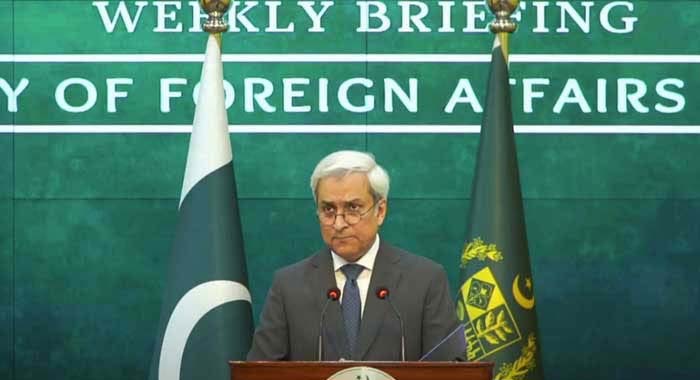
Pakistan has reiterated that its border with Afghanistan will remain closed until the Afghan government provides firm and verifiable assurances to prevent terrorists from crossing into Pakistani territory. Speaking during the weekly press briefing, Foreign Office spokesperson Tahir Hussain Andarabi emphasized that the border closure is not limited to groups such as Tehrik-e-Taliban Pakistan (TTP) or Tehrik-e-Taliban Afghanistan (TTA). “Even Afghan nationals have been involved in serious crimes in Pakistan. The context of the border closure should be understood purely from a security perspective,” he said.
Andarabi stressed that Pakistan has no dispute with the people of Afghanistan, whom it regards as brothers and sisters. The measure is entirely motivated by security concerns. He highlighted that Pakistan has consistently facilitated aid corridors for Afghan citizens, and the current border policy is aimed at practical cooperation to curb cross-border terrorism. “Until the Afghan government provides solid assurances that terrorists and violent elements will not enter Pakistan, the border will remain closed,” he added.
Responding to questions about reports on Pakistan-Afghanistan negotiations in Saudi Arabia, Andarabi acknowledged the media coverage and noted that a high-level Turkish delegation, announced by President Erdogan two weeks ago, was scheduled to visit Islamabad. He added that delays could be due to scheduling or lack of cooperation from the Taliban. He reaffirmed that Pakistan’s border measures are intended solely to protect its citizens from terrorism.
Addressing other regional developments, the spokesperson said President Putin’s visit to India is a bilateral matter between two sovereign nations, and Pakistan holds no specific position regarding potential defense agreements between India and Russia.
Commenting on concerns over India’s treatment of Muslims, Andarabi stressed that discriminatory state policies have emboldened extremist organizations. He recalled that December 6 marks the 33rd anniversary of the Babri Masjid demolition, an event that continues to cause concern and grief. He added that transparent accountability is essential for any actions that damage Muslim religious symbols and historical heritage, and that the desecration of sacred sites violates the principles of religious equality.



