
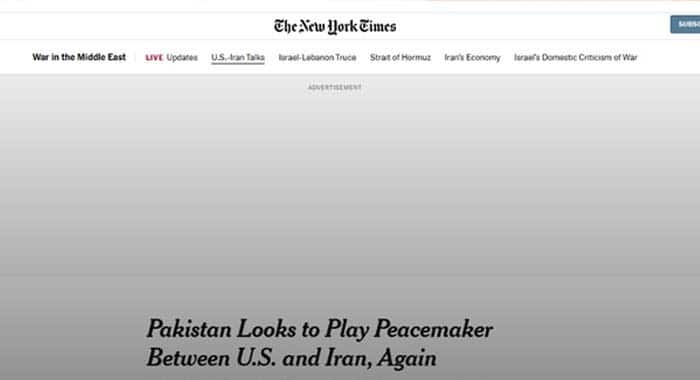
According to a report published by The New York Times, Pakistan has emerged as a significant intermediary in facilitating diplomatic engagement between the United States and Iran, contributing to a temporary two-week ceasefire arrangement and offering Islamabad as a prospective venue for continued negotiations.
The report highlights Pakistan’s growing diplomatic relevance at a critical moment in regional geopolitics, noting that Islamabad has been increasingly viewed by both Washington and Tehran as a credible and trusted communication channel.
A central development outlined in the report is the visit of Pakistan’s Chief of Army Staff, Field Marshal Asim Munir, to Iran. The visit, described as part of sustained peace efforts, was reportedly welcomed by U.S. officials, with the White House acknowledging Pakistan’s constructive role in facilitating dialogue between the two sides.
The report further indicates that discussions are underway for a second round of U.S.–Iran negotiations, with Islamabad being considered as a possible host location. However, no official confirmation regarding the timing or final arrangements has been issued by either party.
Pakistan’s diplomatic engagement, as described in the report, reflects a notable shift in its regional posture, transitioning from managing immediate regional tensions to actively supporting broader conflict resolution initiatives. This includes its recent involvement in managing complex geopolitical dynamics involving neighboring states such as Afghanistan and India.
The report also notes that Prime Minister Shehbaz Sharif has engaged with leadership in Saudi Arabia as part of Islamabad’s broader diplomatic outreach, aimed at balancing relationships amid evolving regional alignments involving Iran and Gulf states.
According to The New York Times, Pakistan’s growing role is underpinned by its unique positioning as a state trusted by multiple stakeholders. Both the United States and Iran reportedly view Islamabad as a viable intermediary capable of sustaining dialogue and facilitating negotiations at a sensitive diplomatic juncture.
The analysis concludes that Pakistan’s emergence as a mediator reflects its evolving strategic importance, highlighting its potential to play a long-term role in facilitating dialogue and reducing tensions in one of the world’s most complex geopolitical landscapes.



