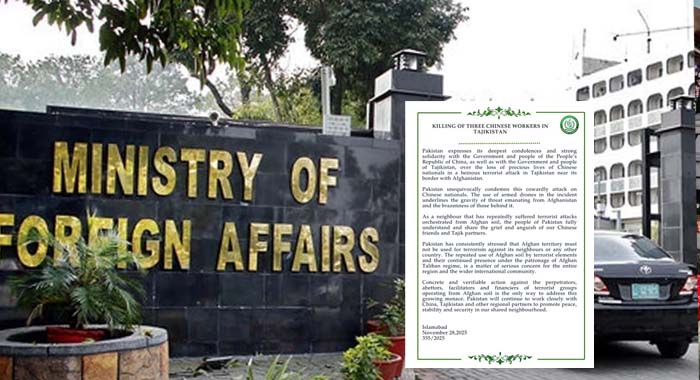
Pakistan has strongly condemned the drone attack in Tajikistan that resulted in the deaths of three Chinese nationals, describing the incident as a “cowardly terrorist act.” The Foreign Office statement emphasized that the use of an armed drone underscores the severity of threats emanating from Afghanistan and the brazenness of the elements behind this attack.
Tajik authorities reported on Thursday that three employees of a Chinese company were killed near the Afghanistan-Tajikistan border in Tajikistan’s southern region. According to the Tajik Ministry of Foreign Affairs, the attack involved a drone equipped with firearms and grenades. Dushanbe, which rarely comments publicly on such incidents, did not specify the perpetrators.
Pakistan’s Foreign Office, in a statement issued Friday morning, expressed condolences and solidarity with the families of the victims and the governments of China and Tajikistan. The statement said, “Pakistan unequivocally condemns this cowardly attack. The use of an armed drone highlights the threat emanating from Afghanistan and the audacity of its backers.”
The statement added, “As a neighboring country that has repeatedly faced organized terrorist attacks originating from Afghan soil, Pakistan fully shares the grief and distress of its Chinese friends and Tajik partners.”
Pakistan reiterated that Afghan territory must not be used for terrorism against neighboring countries or any other state. “The repeated use of Afghan soil by terrorist elements, often under the protection of the Afghan Taliban administration, is a matter of serious concern for the entire region and the international community,” the statement said.
The Foreign Office stressed that only concrete and verifiable action against terrorists operating from Afghan soil, along with their facilitators and financial supporters, can mitigate this growing threat. It affirmed Pakistan’s commitment to close cooperation with China, Tajikistan, and other regional partners to promote peace, stability, and security.
Bilateral ties between Pakistan and Afghanistan have been strained recently, primarily due to the outlawed Tehreek-e-Taliban Pakistan (TTP), which continues to pose a major security challenge. Pakistan has repeatedly called on the Kabul administration to take effective measures to prevent cross-border terrorism. Afghan authorities, however, deny allowing militants to use Afghan territory for attacks on Pakistan.
Last week, the head of the UN Security Council’s committee on sanctions against ISIS and Al-Qaeda, representing Denmark, highlighted the “serious threat” posed by TTP in Central and South Asia, noting the group’s access to “logistical and substantial support” from Afghan authorities.
Tajikistan, a Muslim-majority nation and one of the poorest countries of the former Soviet Union, has expressed growing concerns about extremism since the Taliban’s return to power in 2021. Armed groups remain active along the nearly 1,350-kilometer mountainous border with Afghanistan.
President Emomali Rahmon, in power since 1992, has openly criticized the Taliban and consistently urged the group to respect the rights of ethnic Tajiks, who constitute roughly a quarter of Afghanistan’s population. At the same time, Tajikistan has cautiously maintained limited engagement with the Taliban, including diplomatic meetings, cross-border markets, and electricity supply.
On Thursday, the Tajik Ministry of Foreign Affairs stated that criminal groups based in the neighboring country continue to attempt destabilization in border areas.