
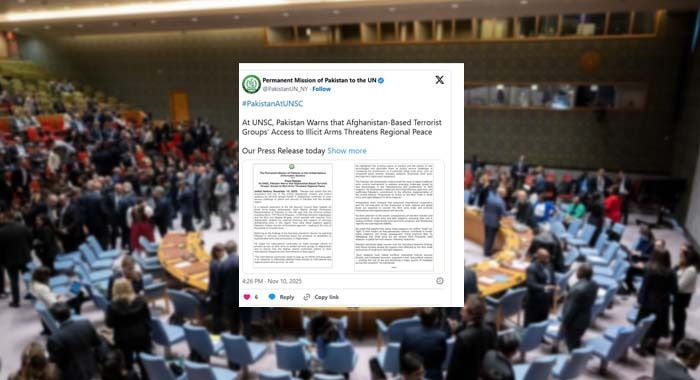
Pakistan has called on the international community to take immediate and effective action to prevent the illegal supply of weapons to terrorist organizations operating in Afghanistan, urging that the Afghan Taliban fully comply with their international obligations and commitments regarding arms control. According to a report published in Dawn newspaper, Pakistan specifically highlighted groups such as Tehreek-e-Taliban Pakistan (TTP), the Baloch Liberation Army (BLA), and its Majid Brigade, which remain active despite United Nations sanctions.
Pakistan’s Permanent Representative to the United Nations, Ambassador Asim Iftikhar Ahmed, briefed the UN Security Council, stating that seized weapons along the Pakistan-Afghanistan border are linked to stockpiles left behind after the withdrawal of foreign forces from Afghanistan or have entered the region’s black market. His remarks came during a debate on small arms and light weapons, presided over by Sierra Leone, the Council President for November.
Ambassador Ahmed expressed deep concern over the presence of sophisticated and lethal weapons in Afghanistan, emphasizing that these pose a direct threat to neighboring countries. He noted that the unregulated movement of unmarked or unregistered arms across the international border enables non-state armed groups, terrorist networks, and criminal organizations, undermining regional stability and security.
He warned that terrorist groups in Afghanistan continue to use these advanced weapons to target Pakistani citizens and law enforcement agencies, resulting in the loss of thousands of innocent lives. Among the groups identified were ISIS-K, TTP (including Fitna al-Khawarij), BLA, and the Majid Brigade, which operate with external financial support and serve as destabilizing forces in the region.
Ambassador Ahmed called on the international community to intensify its efforts, address gaps in response mechanisms, and effectively mitigate threats to global and regional peace and security. He stressed that the illegal transfer and uncontrolled use of small arms prolong conflicts, obstruct socio-economic development, and significantly diminish prospects for regional stability.
“These weapons are neither small nor light in their impact,” he said, noting that they hinder development, are used in human rights violations, and pose serious risks to peace and stability.
He further highlighted emerging challenges from new technologies, including 3D-printed firearms and the digital circulation of weapons schematics online, emphasizing the need for international cooperation and robust control measures to fully address these threats.
UN and civil society leaders have repeatedly briefed the Security Council on the urgent need to curb the deadly and destabilizing flow of small arms. UN Deputy High Representative for Disarmament, Adiji Ebo, reported that over one billion firearms are in circulation worldwide, fueling ongoing global security crises.
Referring to the UN Secretary-General’s latest biennial report, Ebo noted that while some progress has been made at global and regional levels, significant challenges persist. The illegal trade and misuse of small arms continue to exacerbate violence, terrorism, and organized crime globally, as evidenced by repeated violations of arms embargoes in countries such as Libya, Yemen, and Haiti.
He warned that theft or diversion of weapons from national stockpiles or supply chains can place them into the hands of non-state actors. Ebo highlighted that illegally manufactured arms, including 3D-printed guns, are increasingly available in black markets worldwide.
Illegal civilian acquisition of firearms often reflects weak governance and ineffective security systems. In such environments, individuals arm themselves for self-protection, but uncontrolled access to weapons frequently results in human tragedies. Ebo disclosed that in 2024 alone, small arms were responsible for the deaths of 48,000 civilians, marking a 40 percent increase compared to 2023.
Pakistan’s call to the international community underscores the urgent need for coordinated action to prevent the use of Afghanistan-based weapons by terrorist groups targeting Pakistan and to safeguard regional peace and stability.



