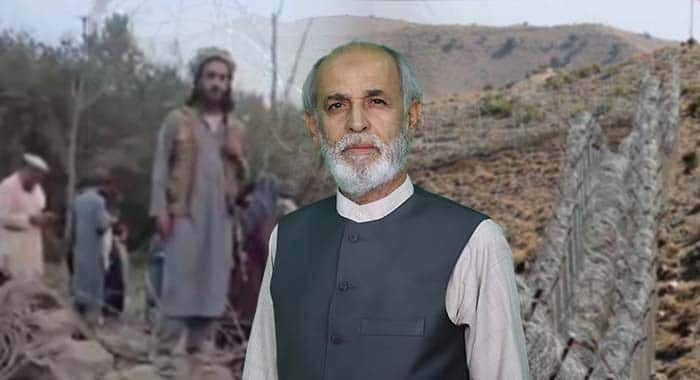
Shamim Shahid
The security situation between Pakistan and Afghanistan has once again reached a critical and deeply worrying point. After several months in which tensions appeared comparatively restrained, the relationship between the two neighbours is again being dominated by allegations of terrorism, military operations, border clashes, diplomatic confrontation and increasingly harsh rhetoric. What makes the current situation particularly dangerous is that these developments are taking place at a time when attempts are also being made to bring the two sides closer through diplomatic mediation. Instead of creating a stable environment for dialogue, however, fresh attacks and counter-allegations appear to be pushing Islamabad and Kabul further apart.
Pakistan’s Defence Minister Khawaja Asif has made a particularly serious allegation, claiming that approximately 70 to 80 percent of attacks in Pakistan targeting mosques, schools, markets and military installations are connected to Afghanistan. The allegation reflects Islamabad’s growing concern that militant groups responsible for attacks inside Pakistan are operating from, receiving support in, or finding refuge across the Afghan border. Afghanistan, however, has objected strongly to such accusations and has repeatedly rejected the suggestion that its territory is deliberately being used to facilitate attacks against Pakistan. The disagreement over this issue has become one of the most difficult obstacles in the relationship between the two countries.
The deadly suicide attack on the Kohat Police Lines has further intensified the security debate. The attack has become another painful reminder that the threat of terrorism in Khyber Pakhtunkhwa remains serious. The allegation that the attack has links to Afghanistan adds another layer to an already highly sensitive situation. Yet such allegations must ultimately be established through credible evidence and investigation. In an atmosphere where both governments distrust one another, every terrorist attack can rapidly become a diplomatic crisis, while every military response can become another source of confrontation.
Senior journalist Shamim Shahid, while assessing the worsening relationship between Pakistan and Afghanistan, described the situation as moving in a very dangerous direction. His assessment reflects the broader concern that the tension between the two countries is no longer merely diplomatic. It is increasingly taking a security and military dimension. According to the analysis presented in the discussion, after months of relative silence there has once again been a sharp and intense increase in tensions.
The recent sequence of incidents has added to those concerns. Attacks have been reported in Kurram, Kohat and Hangu, while smaller security incidents and militant operations continue to occur on a regular basis. Pakistan has blamed Afghanistan for facilitating or harbouring militants responsible for such attacks, while Afghanistan has rejected the accusations. This exchange of accusations has created a familiar and dangerous cycle in which each new incident deepens the mistrust created by the previous one.
The timing is particularly significant because diplomatic efforts have also been taking place. On Friday, Türkiye and Qatar were involved in mediation efforts between Pakistan and Afghanistan. Their role is important because direct trust between Islamabad and Kabul has repeatedly deteriorated during periods of crisis. Third-party mediation can sometimes create a diplomatic space in which both sides can communicate without immediately turning every disagreement into a public confrontation. Yet even as these diplomatic efforts were being discussed, new attacks and reports of military activity emerged, raising concerns about whether there are forces that do not want reconciliation between the two countries.
It is tempting in such circumstances to speak about mysterious or hidden hands attempting to sabotage peace. The possibility that militant organisations or other influential actors may benefit from continued tension cannot simply be dismissed. However, accusations about unidentified actors should not be treated as established facts without evidence. What is clear is that continued violence serves the interests of those who thrive in instability. Militants benefit when states are distracted by confrontation, while criminal networks and other destabilising actors can exploit weak governance and insecure borders.
The situation became even more alarming with reports of Pakistani airstrikes in parts of Afghanistan. Reports referred to strikes in the northern Afghan provinces of Kunar and Paktia, as well as reported military activity in Birmal. These reports have heightened fears that the crisis could move beyond accusations and militant attacks and develop into direct confrontation between the security forces of the two countries.
The border areas around Ali Zazai, Zazai Maidan and Tary Mangal are particularly sensitive. Tary Mangal is on the Pakistani side while Zazai Maidan is on the Afghan side, and the two areas are closely connected geographically and socially. Reports of fighting or exchanges involving Pakistani and Afghan security forces in such locations demonstrate how quickly instability can move from militant activity to state-to-state confrontation.
At the time discussed in the interview, there had been no comprehensive official Pakistani statement confirming all of these reported incidents. However, reports from Afghanistan indicated that three people had been killed and four injured in Kunar, with the reported casualties described as civilians. There were also reports of an attack on a house in Paktia, although no confirmed casualty figures were immediately available. Such reports underline the importance of independent verification because conflicting narratives during a security crisis can easily deepen public anger on both sides.
The civilian dimension must never be forgotten. Whether the reported casualties result from military operations, militant attacks or cross-border clashes, civilians are ultimately the people who bear the consequences of deteriorating relations. Border communities do not have the ability to control diplomatic decisions made in Islamabad or Kabul. Yet they are often the first to experience displacement, fear, economic disruption and violence when relations between the two governments collapse.
Another important issue raised in the discussion concerns Pakistan’s military operations against militants near the border. Pakistan’s Inter-Services Public Relations has reported operations in which 28 militants were reportedly killed. The discussion also referred to another statement concerning eight attacks near the border. These figures demonstrate the intensity of the security challenge and the scale of the military response.
But the existence of military operations raises another important question: if militants are repeatedly being targeted, why do attacks continue to occur? Military action can eliminate individuals and disrupt militant networks, but terrorism is rarely defeated through force alone. Intelligence gathering, policing, border management, local administration, political stability and public cooperation are equally important.
The timing of these attacks is also significant. They are occurring while Pakistan and Afghanistan are attempting, at least periodically, to find a diplomatic path forward. That makes every new terrorist incident particularly damaging to the prospects of reconciliation. If an attack occurs immediately before or during negotiations, public pressure for retaliation increases, while the political space for compromise shrinks.
The growing number of attacks in Kurram, Kohat and Hangu therefore deserves serious attention. The problem is not limited to one isolated location. Smaller attacks and security incidents are also being reported on a continuing basis. This suggests that militant organisations continue to possess the ability to exploit vulnerabilities across a wide geographical area.
The question is now unavoidable: where is the situation heading?
If the confrontation develops into direct conflict between Pakistan and Afghanistan, the consequences could be extremely serious. Once regular armed forces begin confronting each other, diplomacy becomes much more difficult. Public emotions become stronger, political leaders become less willing to compromise, and every incident becomes a potential trigger for further escalation.
That is why the idea of bringing Pakistan and Afghanistan back to the negotiating table must not be abandoned. The situation may be tense, but precisely because it is tense, communication is essential. The two governments do not have to agree on every issue before they begin talking. In fact, dialogue is most necessary when disagreement is greatest.
Direct negotiations, however, may be difficult at the present moment because of the intensity of the rhetoric. This is where impartial or mutually acceptable mediators could play an important role. Türkiye and Qatar have already demonstrated their willingness to facilitate communication between the two sides. Their involvement could provide a diplomatic channel at a time when Islamabad and Kabul may find it difficult to communicate effectively with each other.
The mediation process should not necessarily be limited to serving government officials. There is also value in involving respected political figures, former ambassadors, former diplomats, technocrats, religious scholars and other individuals with experience in diplomacy and conflict resolution. Such people may be able to communicate with actors whom official representatives cannot easily reach.
Religious leaders could also play a role, particularly because the Afghan Taliban government derives much of its political identity from its religious framework. Engagement with credible religious scholars does not mean accepting every ideological position of the Taliban. Rather, it recognises that religious and social leaders can sometimes influence communities and help create space for de-escalation.
But expectations must remain realistic. This is not a dispute that can be solved in one meeting, one telephone call or one evening of negotiations. The problems between Pakistan and Afghanistan have accumulated over many years. They involve terrorism, border security, sovereignty, refugees, political mistrust, militant networks and competing regional interests. Resolving such issues requires sustained and patient negotiations.
The demands being made by both sides have also become increasingly harsh. Pakistan wants stronger guarantees that Afghan territory will not be used for attacks against Pakistan. Afghanistan strongly objects to accusations against it and rejects actions that it considers violations of its sovereignty. As these demands become more rigid, the space for compromise becomes smaller.
That is precisely why patience is needed.
If the leaders of both countries genuinely want peace in the region, they must understand that diplomacy requires restraint. A harsh statement may satisfy a domestic audience for a few hours, but it can make negotiations much harder for months. Similarly, a military response may appear to offer an immediate solution to a security problem while simultaneously creating new political and humanitarian complications.
The wider regional environment makes restraint even more important. The discussion also referred to serious tensions in the Gulf involving Saudi Arabia, Iran and the United States. In such a complicated regional environment, Pakistan and Afghanistan should avoid opening another major front of instability. Neither country can afford the economic, political and humanitarian consequences of a prolonged conflict.
Pakistan’s internal security situation is equally concerning. The question is not simply whether militant attacks are connected to Afghanistan. Pakistan must also examine why militants continue to find opportunities to attack inside the country.
The recent incidents in Kohat, Hangu and Kurram demonstrate the problem. If security arrangements were completely effective, these attacks would not be occurring. Of course, no state can prevent every terrorist attack, but repeated attacks indicate vulnerabilities that require urgent attention.
Militants are constantly searching for weak points. They look for locations where security is inadequate, where routines are predictable and where an attack can create maximum fear. These vulnerable areas can become what security experts often describe as soft targets or soft spots.
The geographical areas mentioned in the discussion—including Kohat, Kurram, Hangu, North Waziristan, South Waziristan, Bannu, Lakki Marwat, Peshawar and Tirah—illustrate the breadth of the challenge. These areas cannot be treated as isolated security problems. They are connected by geography, transportation routes, communities and the wider security environment of Khyber Pakhtunkhwa.
There is therefore a possibility that militants could attempt to exploit another vulnerable location in the future. That possibility should not be ignored. Security agencies need to remain vigilant, but vigilance alone is not enough.
The federal government, the Khyber Pakhtunkhwa government, police, intelligence agencies, military institutions and other state organisations need to work together. Security cannot become another arena for political rivalry. If federal and provincial authorities blame one another instead of coordinating, militants gain an advantage.
The public also has an important role. If the government takes credible and effective steps, citizens are more likely to cooperate with security institutions. Communities can provide valuable information, assist law-enforcement agencies and help identify suspicious activity. But cooperation requires trust.
And trust is precisely what appears to be weakening.
The discussion highlights growing public carelessness and a lack of confidence in government institutions. People may feel that neither the provincial government nor the federal government is adequately addressing their concerns. Political differences between governments can further deepen this perception.
This is a serious problem because security is not sustainable without public confidence.
A government can deploy security forces, establish checkpoints and conduct operations, but if citizens believe that institutions are divided or ineffective, the overall security environment remains vulnerable. Restoring public trust must therefore become part of the security strategy.
The government needs to communicate clearly with citizens about threats without creating unnecessary panic. It needs to explain what measures are being taken. It needs to investigate attacks transparently. It needs to hold institutions accountable where failures occur. And it needs to ensure that political disagreements do not interfere with the protection of citizens.
At the same time, Pakistan must distinguish between legitimate security requirements and actions that could produce wider instability. If Islamabad has evidence that militant groups are operating from Afghan territory, that evidence should be presented through diplomatic and security channels. Afghanistan should be pressed to take meaningful and verifiable action.
But Afghanistan also needs a credible mechanism through which it can present its own objections. If Kabul believes that Pakistani allegations are incorrect or that Pakistani military operations are harming civilians, those concerns should be investigated rather than allowed to become another justification for escalation.
This is why a monitoring mechanism could be so important.
Both sides need a system through which allegations can be independently examined, incidents can be documented and commitments can be verified. Without verification, each government will continue to rely primarily on its own narrative, while the public will be left trying to determine which version of events to believe.
The central challenge is therefore not simply terrorism. It is the combination of terrorism, mistrust, weak communication, political rivalry and military escalation.
Each problem reinforces the others. Terrorist attacks increase mistrust. Mistrust produces military action. Military action produces anger. Anger makes diplomacy more difficult. The collapse of diplomacy creates more space for militants to operate. And another attack then begins the cycle again.
Breaking that cycle will require political courage from both sides.
Pakistan cannot compromise on the safety of its citizens. Afghanistan cannot be expected to surrender its legitimate sovereignty concerns. But security and sovereignty do not have to be mutually exclusive.
The two countries can establish mechanisms to address terrorism without moving toward permanent confrontation. They can strengthen border security while keeping trade and legitimate movement open. They can investigate incidents without immediately resorting to retaliation. They can use mediators when direct communication becomes difficult.
Most importantly, they can recognise that peace does not mean the absence of disagreement.
Peace means having a system through which disagreement can be managed without turning into war.
The people of Khyber Pakhtunkhwa have already experienced enough violence. Communities in Kohat, Hangu, Kurram, North and South Waziristan, Bannu, Lakki Marwat, Peshawar and Tirah know the human cost of insecurity. Across the border, Afghan civilians likewise have little control over decisions taken by governments and armed groups but often pay the price for them.
They deserve better than another cycle of violence.
Pakistan and Afghanistan now face a choice between escalation and sustained engagement. Neither side needs to surrender its position. Neither needs to pretend that its security concerns are imaginary. But both must recognise that continuing on the present trajectory carries enormous risks.
The reports of attacks, the accusations of cross-border terrorism, the reported airstrikes, the clashes around sensitive border areas, the killing of militants, the civilian casualties, the political rhetoric and the growing public distrust all point toward the same conclusion: the situation cannot be allowed to deteriorate indefinitely.
Türkiye and Qatar can help. Former diplomats can help. Political leaders, technocrats and religious scholars can help. Security officials can help. Civil society can help.
But ultimately, the responsibility belongs to Islamabad and Kabul.
Both governments must show patience. Both must keep channels of communication open. Both must investigate rather than speculate. Both must protect civilians. Both must confront terrorism. And both must understand that military strength without diplomacy cannot create lasting stability.
The greatest danger today is not merely another terrorist attack or another border clash.
It is the possibility that Pakistan and Afghanistan become trapped in a permanent confrontation in which neither side trusts the other enough to negotiate and neither side is willing to stop escalating.
That would be a tragedy for both countries. The region does not need another conflict. Khyber Pakhtunkhwa does not need another generation growing up under the shadow of terrorism. Afghanistan does not need another period of instability. Pakistan does not need another security crisis on its western border.
What is required now is not surrender, silence or empty rhetoric. What is required is serious diplomacy backed by credible security measures.
The path will be difficult and the negotiations will be long. But if Pakistan and Afghanistan genuinely want peace, they must return to the table, accept the assistance of credible mediators, involve respected figures from both societies and develop a practical formula for addressing terrorism, border security, sovereignty and civilian protection.
The choice is ultimately between continuing a cycle that has repeatedly failed and building a mechanism capable of breaking it.
Pakistan needs security. Afghanistan needs stability. The people on both sides of the border need peace. And the time to prevent today’s dangerous confrontation from becoming tomorrow’s permanent conflict is now.