
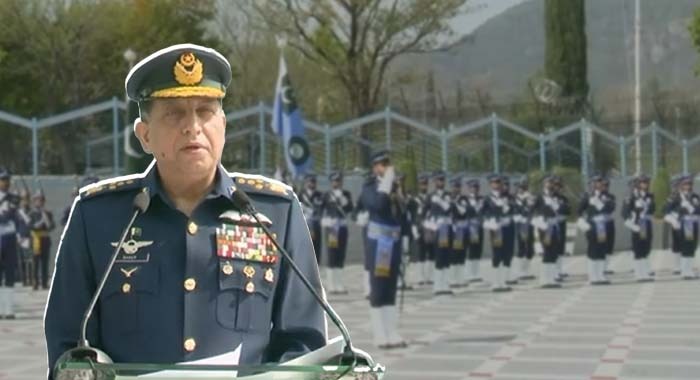
The Pakistan Air Force (PAF) today marked the 7th anniversary of Operation Swift Retort, a defining moment in the country’s modern military history. The event, held at Air Headquarters, served as a solemn reflection of the PAF’s resolve, professionalism, and unmatched capabilities in modern air warfare.
The ceremony was attended by top military leadership, including Air Chief Marshal Zaheer Ahmed Baber Sidhu, NI (M), HJ, Chief of the Air Staff, who delivered a stirring address that underscored Pakistan’s commitment to peace, national sovereignty, and the evolving nature of global and regional security.
In his address, Air Chief Marshal Zaheer Baber Sidhu recalled the events of seven years ago when Pakistan’s sovereignty was challenged by an aggressor under the cover of darkness. He remarked that the adversary miscalculated Pakistan’s resolve and capability. In response, the Pakistan Air Force conducted a precisely calibrated and powerful broad daylight counter-strike, reinforcing a strong deterrence against a numerically superior enemy.
“Pakistan is a responsible country which desires peace with honour,” stated the Air Chief, highlighting the country’s unwavering stance on national security and its continued pursuit of peace while ensuring that Pakistan’s sovereignty is never compromised.
The Air Chief also discussed the rapid evolution of the PAF in a complex global and regional security environment. He emphasized the importance of modernization, noting that despite fiscal constraints since March 2021, PAF has significantly advanced its capabilities. The PAF is transitioning into a Next Generation Air Force, ensuring the country remains ahead of emerging threats and challenges in modern warfare.
He further elaborated on the PAF’s progress in indigenization, which includes the integration of cutting-edge technologies such as Unmanned Aerial Systems (UAS), Electronic Warfare, Space, and Cyber capabilities. By recalibrating its operational doctrine, the PAF has developed a unique home-grown multi-domain Kill Chain, setting it apart as one of the most advanced air forces in the region.
Referring to Marka-e-Haq in May 2025, the Air Chief highlighted PAF’s first-ever full-spectrum multi-domain operations. These operations were executed with precision, decisively overwhelming the adversary and further establishing the credibility of Pakistan’s defense capabilities.
One of the most significant achievements during Marka-e-Haq was the successful downing of several advanced enemy platforms, including Rafale, SU-30 MKI, Mirage-2000, MiG-29, and Unmanned Aerial Systems. Additionally, PAF carried out strikes deep inside hostile territory, targeting and neutralizing S-400 air defense systems along with their Command and Control Centres. This marked a critical milestone in Pakistan’s defense strategy, showcasing the PAF’s ability to conduct high-stakes, complex operations in real-time combat environments.
Reaffirming PAF’s ongoing commitment to Pakistan’s national security, the Air Chief stressed that the PAF will continue to remain a symbol of pride for the nation, ensuring a credible deterrence and a vigilant yet responsible defense posture. The PAF, he emphasized, is not only committed to safeguarding Pakistan’s sovereignty but also contributes to regional peace and stability, standing ready to protect the nation from any external threat.
“Our resolve remains unyielding,” Air Chief Marshal Sidhu said. “We will continue to ensure that Pakistan’s skies are safeguarded with excellence, determination, and professionalism.”
The ceremony also looked ahead to the future, with the Air Chief highlighting the need for continued investment in modern defense technologies, training, and strategic partnerships. With the evolving nature of warfare, the PAF remains focused on staying ahead of potential threats, strengthening Pakistan’s deterrent capability, and contributing to regional peace.
As the Pakistan Air Force continues to adapt to changing global dynamics, it remains steadfast in its mission: ensuring the protection of Pakistan’s sovereignty and the security of its people, while maintaining a posture that fosters peace and stability in the region.



