
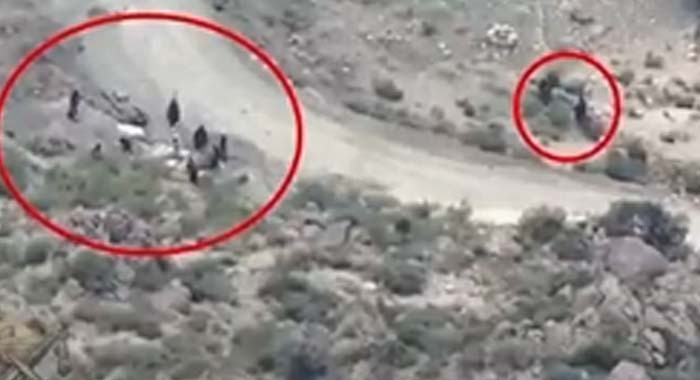
Pakistan’s recent security developments, spread across multiple incidents reported during the day, collectively sketch a rapidly evolving security landscape in which Islamabad is attempting to seize both the military and psychological initiative against militant networks operating from Afghan soil.
At the center of this escalation is Operation Ghazab Lil Haqq, which Pakistani authorities describe as a calibrated campaign targeting militant infrastructure and support networks linked to the Tehreek-e-Taliban Pakistan. According to official figures shared by Information Minister Attaullah Tarar, Pakistani retaliatory actions have resulted in 415 Afghan Taliban fighters killed and 580 wounded so far, a figure intended to underline the scale and effectiveness of the operation.
Simultaneously, Pakistan’s air power has been used to strike strategic military installations in Kabul, Kandahar and Paktia, locations believed to host or facilitate militant activity. Security sources say key brigade headquarters and logistical sites were hit during precision airstrikes carried out by the Pakistan Air Force. The strikes signal a willingness by Islamabad to target not only militant foot soldiers but also the infrastructure that sustains them.
Parallel to the external pressure across the border, internal security operations continue within Pakistan. Joint operations by police and security forces in Khyber district resulted in the arrest of a wounded militant during a firefight in Bara’s Largo Pul area. These tactical operations indicate that the campaign is unfolding simultaneously across multiple fronts, from tribal districts to the Afghan border.
At the same time, violence linked to militant groups has not entirely subsided. A suspected suicide attack targeting a police checkpoint at the inter provincial Dajal checkpoint connecting Punjab and Khyber Pakhtunkhwa killed three police personnel and injured several others, prompting authorities in Bhakkar district to place security agencies on high alert.
Taliban Under Pressure on Multiple Fronts
Taken together, these developments suggest that the Taliban leadership is facing an increasingly complex situation. Pakistani strikes inside Afghanistan have been accompanied by a visible shift in the Taliban’s public messaging. Statements from Kabul have attempted to distance the regime from the TTP, sometimes referring to the group as “Fitna al Khawarij,” language that hints at internal friction or at least diplomatic maneuvering under pressure.
Within 24 hours of the escalation, signals reportedly emerged indicating Taliban willingness to consider talks with Pakistan. Whether these signals represent a genuine policy shift or a tactical pause remains unclear, but the timing reflects the immediate impact of Pakistan’s military actions.
Strategically, Islamabad appears to be pursuing a dual objective. First, to degrade militant operational capacity through targeted strikes and arrests. Second, to shape the political narrative by forcing the Taliban leadership to publicly confront the issue of cross border militancy.
This approach also reflects a broader doctrine increasingly visible in Pakistan’s counterterrorism strategy. Military pressure is paired with narrative warfare, aimed at stripping militant groups of ideological legitimacy while isolating them diplomatically.
The unfolding situation therefore represents more than isolated security incidents. It is part of a broader contest over territory, influence and narrative control along the Pakistan Afghanistan frontier, where military operations, border security, and political signaling are converging into a single, high stakes confrontation.



